About the Author and Medical Reviewer
Learn more about the professionals responsible for writing and medically reviewing this article.

Alma Polyclinic Editorial Team
Medical Content Team at Alma Polyclinic
The Alma Polyclinic Editorial Team creates clear, patient-focused health content based on trusted medical sources and clinical guidance from our doctors.
View author profile
Dr. Tamara AK
General Dentist | Cosmetic & Aesthetic Dentistry at Alma Polyclinic
This article was reviewed for clinical accuracy, relevance and patient safety by Dr. Tamara AK.
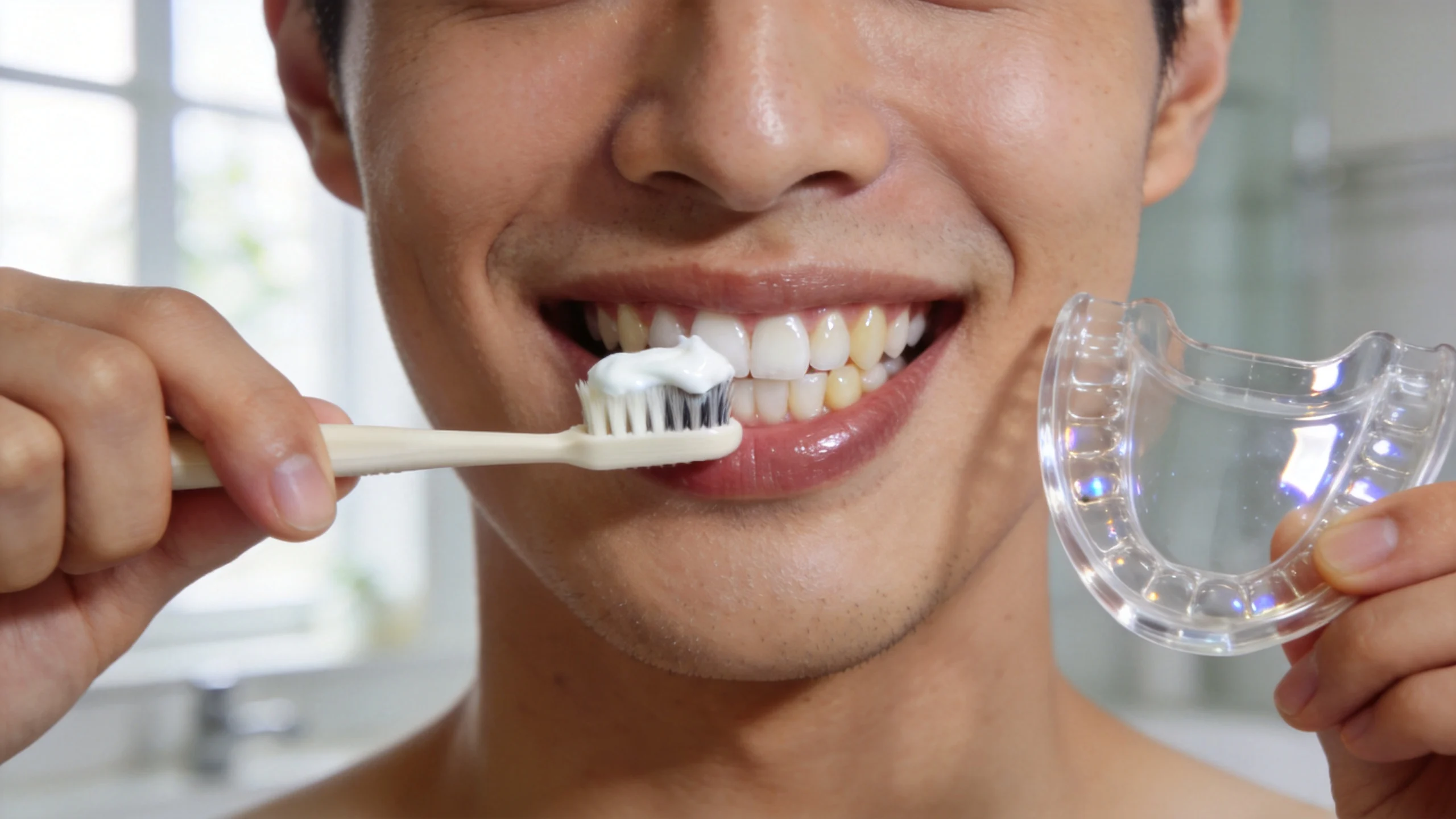
View doctor profileIf you are wondering about teeth whitening before or after brushing, the honest answer is: it depends on the whitening product you are using. Whitening strips, trays, gels, whitening toothpaste, mouthwash-style products, and professional whitening can all have different instructions.
The safest approach is not to guess. Start with the label, package insert, or your dentist’s directions. Then build your brushing routine around that. Brushing at the wrong time may not be a big problem in every case, but it can lead to avoidable discomfort, messy application, or confusion about what to do after the whitening product comes off.
This guide breaks down the safest sequence by product type, explains why timing matters, and helps you decide what to do if your routine is not clearly spelled out.
Quick Answer: Should You Whiten Teeth Before or After Brushing?
The safest default is to follow the whitening product instructions
Whitening products are not all used the same way. Some are meant to be applied to clean teeth. Some may include specific directions about brushing, rinsing, or drying your teeth first. Others may tell you what to do after the product is removed.
Because formulas, wear times, and application methods vary, there is no single rule that applies to every whitening product. The instructions on your product label, the insert inside the box, or the guidance from your dentist should override general advice.
If a whitening kit says to brush before use, follow that sequence. If it says not to brush immediately before use, follow that instead. If the directions only mention rinsing after whitening, do not add extra steps unless they fit your normal oral hygiene routine and do not conflict with the instructions.
General rule of thumb by product category
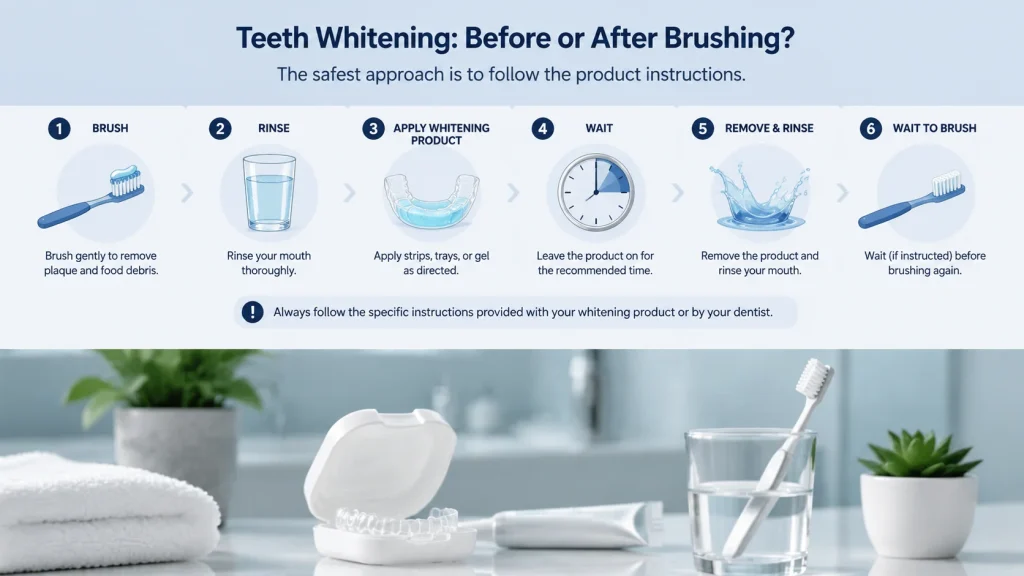
For products applied directly to teeth, such as whitening strips, trays, gel pens, or whitening gel, many routines work best when the teeth are free of obvious food debris and plaque. Clean tooth surfaces can make placement easier and help the product sit where it is supposed to sit. However, the exact brushing timing may still vary by product.
For whitening toothpaste, brushing is the whitening step. You do not whiten before or after brushing with a separate product unless you are intentionally combining products, which should only be done according to the labels or with dentist guidance.
For whitening mouthwash, the sequence depends on the label and your broader oral care routine. Some people use mouthwash at a different time from brushing. Others use it as part of a morning or evening routine. The product instructions matter here.
For professional whitening, follow the dentist’s before-and-after care plan. In-office whitening and dentist-supervised take-home whitening may come with custom instructions based on your teeth, gums, sensitivity level, and the whitening system being used.
When not to guess
Do not guess about brushing timing if the instructions are unclear, if your teeth already feel sensitive, or if your gums are irritated. It is also smart to ask a dentist before whitening if you have visible dental work such as veneers, crowns, fillings, or bonding.
You should also avoid starting a whitening routine without advice if you suspect an active dental problem, such as untreated decay, gum inflammation, a cracked tooth, or pain that has not been evaluated. Whitening is cosmetic; it should not replace dental care for discomfort or disease symptoms.
Why Brushing Timing Matters When Whitening Your Teeth
Clean tooth surfaces can affect how evenly a product is applied
Whitening products need contact with the tooth surface to be used as intended. Food debris, heavy plaque, or a film on the teeth can make it harder to place strips smoothly, seat trays evenly, or apply gel neatly.
This does not mean you should scrub harder before whitening. It simply means that, when the product instructions call for clean teeth, a normal gentle brushing routine can help create a cleaner surface for application.
For strips, clean teeth may help the strip lie flatter. For trays, clean teeth can make it easier to seat the tray without food particles getting in the way. For gel pens, a clean surface can make application feel more controlled.
Freshly brushed gums and teeth may feel more sensitive for some people
Some people notice temporary discomfort when whitening is used close to brushing time. Others have no issue at all. Sensitivity can vary based on the person, the product, how the product is applied, and the condition of the teeth and gums.
If your mouth feels uncomfortable, do not push through repeated applications just to stay on schedule. Pause, review the instructions, and check whether you may be brushing too aggressively, using too much gel, placing strips onto the gums, or combining too many whitening products.
If sensitivity is severe, one-sided, persistent, or unusual for you, get dental advice before continuing.
Fluoride toothpaste and whitening products may have different timing needs
Many people are trying to balance whitening with a normal cavity-prevention routine that includes fluoride toothpaste. Others use sensitivity toothpaste or prescription dental products. That can make sequencing more important.
If your whitening instructions conflict with your usual brushing routine, do not assume you should skip your dental product or change how you use it. Ask your dentist how to time whitening around fluoride toothpaste, sensitivity toothpaste, or any prescription products you use.
This is especially helpful if you whiten at night and also rely on a specific nighttime brushing routine.
Brushing too aggressively can increase irritation risk
Brushing should remove debris and plaque. It should not feel like scrubbing a stain out of tile. Pressing harder does not mean your teeth will whiten faster, and it may make your gums feel sore.
Use a gentle technique, especially around the gumline. A soft-bristled toothbrush and careful pressure can help keep your routine comfortable. If brushing before whitening is part of your product’s instructions, think of it as preparing the teeth, not trying to “pre-whiten” them through force.
Timing Guide by Whitening Method
Whitening strips: check whether the label says to brush first
Whitening strips are designed to sit against the teeth for direct contact. Because of that, you should avoid applying strips over food residue or a visibly unclean surface.
However, strip instructions can differ. Some labels may tell you to brush before applying the strips. Others may provide specific timing or preparation steps. Do not invent a waiting period or assume every brand uses the same sequence.
Before opening the strip packet, read the directions and look for wording such as “brush before use,” “do not brush immediately before use,” “rinse after use,” or “remove excess gel.” If the wording is unclear, contact the manufacturer or ask a dental professional.
Whitening trays and gels: use the sequence your kit provides
Whitening trays and gels vary widely. Some are over-the-counter kits. Others are dentist-supervised systems with custom trays. The gel amount, tray fit, and wear time can all influence the instructions you receive.
Clean teeth can help trays seat more comfortably and consistently, but the product’s sequence still comes first. If your kit says to brush first, do so gently. If it gives different preparation steps, follow those instead.
Be careful with excess gel. More gel is not automatically better, and gel that spreads onto the gums may cause discomfort for some users. If your tray feels overloaded, messy, or uncomfortable, stop and review the directions before continuing.
If the instructions are vague, ask the dentist who provided the kit or contact the manufacturer for product-specific guidance.
Whitening toothpaste: brush as directed because brushing is the whitening step
Whitening toothpaste is different from strips, trays, and gels because it is used during brushing. There is no separate question of whitening before or after brushing unless you are combining it with another whitening product.
Use whitening toothpaste according to its label. Results, use frequency, and suitability can vary by product and by person. Avoid the mindset that brushing longer or harder will improve results. Consistent, gentle use as directed is a better approach than aggressive brushing.
If you already have tooth sensitivity, gum irritation, exposed root surfaces, or dental restorations, ask a dentist whether whitening toothpaste is a good fit for your routine.
Whitening mouthwash: place it correctly in your oral care routine
Whitening mouthwash can be confusing because mouthwash may be used before brushing, after brushing, or at another time of day depending on the product and the person’s routine.
Start with the label. Look for instructions about how long to rinse, how often to use it, whether to avoid eating or drinking afterward, and whether it should be used separately from brushing.
If you are also using fluoride toothpaste, sensitivity toothpaste, or prescription products, ask your dentist how to sequence everything. The goal is to keep your oral hygiene routine effective while using the whitening product as intended.
Professional whitening: follow the dentist’s before-and-after care plan
Professional whitening may include in-office whitening, dentist-supervised take-home trays, or a combination of both. Because your dentist can evaluate your teeth and gums, the instructions may be more personalized than an over-the-counter kit.
Your dentist may tailor brushing timing, post-whitening care, and sensitivity management based on your oral health, dental work, and the specific whitening system. Follow that plan rather than general internet advice.
If you are unsure whether to brush before your appointment, after your appointment, or before using take-home trays, call the dental office and ask. That is better than guessing.
How to Brush Before Whitening Without Causing Unnecessary Irritation
Use gentle brushing rather than scrubbing
If your whitening product says to brush before use, brush normally and gently. Your goal is to remove debris and plaque, not to polish your teeth aggressively before whitening.
Pay attention to the gumline, but do not force the bristles into the gums. Use light pressure and take your time. If your gums feel sore after brushing, that may be a sign to ease up before applying a whitening product.
Gentle brushing is especially important if you already know your teeth are sensitive or your gums are easily irritated.
Rinse or wait only if the product instructions say to
Some whitening routines may ask for the mouth to be clean. Others may mention rinsing, drying the teeth, or avoiding certain steps before application. Follow the wording you are given.
Do not add a specific waiting period unless the product instructions or your dentist provides one. If the directions do not make sense, pause before applying the product. It is easier to clarify the sequence first than to troubleshoot irritation afterward.
A good habit is to read the directions before opening strips, filling a tray, or applying gel. Once the product is in your mouth, you may feel rushed and be more likely to guess.
Check your gums and teeth before applying the whitening product
Before whitening, take a quick inventory of how your mouth feels. Look for gum irritation, cuts, sores, tenderness, or unusual sensitivity. If something feels off, postpone whitening and reassess.
Whitening should not feel like something you have to endure through pain. If irritation or sensitivity keeps returning, stop using the product and ask a dental professional for guidance.
This is especially important if discomfort is limited to one tooth, if you have recent dental work, or if you notice gum soreness that does not settle.
Should You Brush After Whitening?
Do not brush immediately after whitening unless your instructions say it is okay
A cautious general approach is to avoid brushing immediately after whitening unless your product instructions say it is okay. This is not a universal medical rule for every product, but it helps prevent unnecessary irritation when your teeth or gums already feel sensitive after whitening.
Check the label for post-use steps. It may tell you to rinse, remove leftover gel, avoid certain foods or drinks, or continue with a specific care routine. Follow those directions first.
If you do brush after whitening because the instructions allow it or your dentist recommends it, use gentle pressure. Do not scrub to remove a whitening product or to try to improve the result.
What to do if whitening gel remains on your teeth
If gel remains on your teeth after removing strips or trays, follow the cleanup directions in your kit. Some products may include instructions for rinsing, wiping away excess gel, or brushing afterward. Others may not.
Do not swallow leftover gel intentionally unless your product directions specifically indicate how the product should be handled after use. If you are unsure, rinse or clean up only in the way the instructions allow, or ask the manufacturer for clarification.
If gel repeatedly spreads onto your gums or feels messy, you may be using too much, placing the strip incorrectly, or dealing with a tray fit issue. Stop and review the directions before the next application.
When your normal nighttime brushing routine conflicts with whitening
Many people whiten before bed because it feels convenient. The problem is that nighttime is also when many people brush with fluoride toothpaste, sensitivity toothpaste, or prescription dental products.
If whitening leaves you unsure whether to brush afterward, plan the routine ahead of time. Read the whitening instructions and decide when brushing fits before you start.
If you use a prescription toothpaste or have a dentist-recommended sensitivity routine, ask your dentist how to time whitening around it. That way you are not choosing between your regular oral hygiene plan and the whitening instructions at the end of a long day.
Comparison: Brushing Before vs. Brushing After Whitening
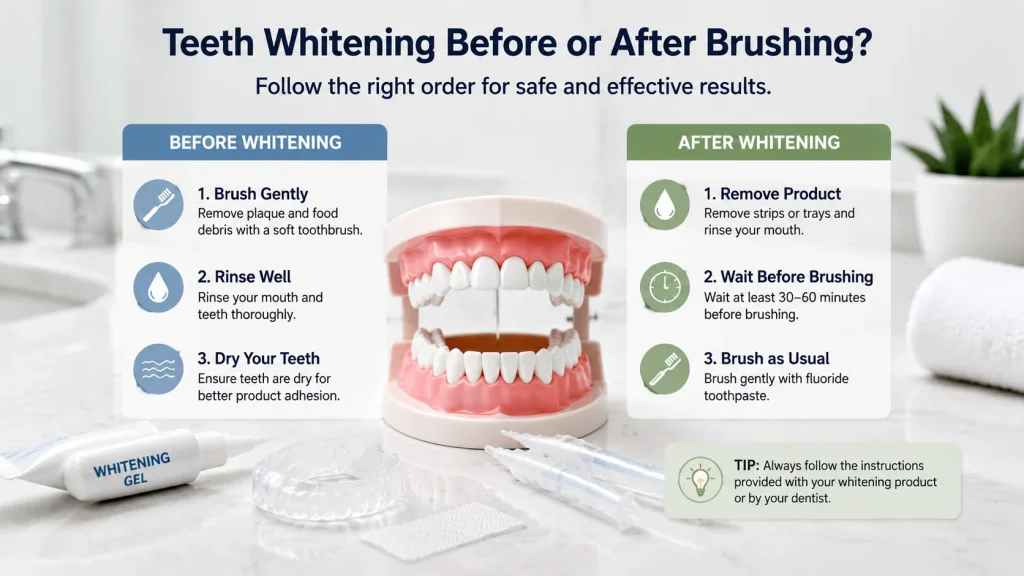
Brushing before and brushing after whitening serve different purposes. One is usually about preparing the teeth for product placement. The other is usually about cleanup or returning to your normal oral hygiene routine. The right choice depends on the product type and the instructions.
| Scenario | Brushing Before Whitening | Brushing After Whitening |
|---|---|---|
| Whitening strips | May be appropriate if the label says to start with brushed or clean teeth. Helps avoid placing strips over food residue. | Only if the label allows it. Follow any post-use rinsing or gel removal steps. |
| Whitening trays or gels | Often connected with clean tooth surfaces and tray placement, but the kit instructions decide the sequence. | Depends on cleanup directions. Avoid aggressive brushing if teeth or gums feel sensitive. |
| Whitening toothpaste | Not a separate step. Brushing is the whitening step. | Not usually relevant unless another whitening product is being used too. |
| Whitening mouthwash | Depends on the mouthwash label and overall routine. | Depends on the label, especially if you also use fluoride or sensitivity toothpaste. |
| Professional whitening | Follow the dentist’s instructions before the appointment or take-home application. | Follow the dentist’s aftercare plan. |
For a morning routine, brushing before whitening may feel natural if the product allows it. For a nighttime routine, the order may be more complicated because you may also be using fluoride toothpaste or sensitivity products. If you have sensitive teeth or dental work, do not rely on a general comparison chart alone; ask for individualized guidance.
What to Avoid Before and After Whitening
Avoid brushing harder to speed up whitening
More pressure does not mean better whitening. Whitening products are designed to be used according to their directions, not intensified with aggressive brushing.
Hard scrubbing can make your gums feel sore and may make the whitening process less comfortable. Instead of increasing pressure, focus on correct placement, correct timing, and consistent use as directed.
Avoid mixing whitening products without guidance
It can be tempting to combine whitening strips, trays, whitening toothpaste, and whitening mouthwash in the same routine. But stacking products can increase confusion and make it harder to know what caused sensitivity or irritation.
Check each label before combining products. If one product has a warning about using it with other whitening products, follow that warning. If you are unsure, ask a dentist before layering multiple whitening methods.
More whitening products do not automatically mean faster or better results. They may simply make your routine harder to manage.
Avoid ignoring sensitivity or gum irritation
Pause and reassess if you notice sharp sensitivity, a burning sensation, gum soreness, white spots on the gums, lingering pain, or discomfort that feels unusual for you.
These symptoms do not always mean something serious is happening, but they are signs that you should stop pushing forward and review your routine. Check whether you brushed too aggressively, left the product on longer than directed, used too much gel, or placed whitening material onto the gums.
If symptoms are persistent, severe, or keep coming back, discuss them with a dental professional.
Avoid whitening over dental problems without advice
Whitening is not the right first step if you have unresolved dental pain, suspected cavities, cracked teeth, gum disease symptoms, or recent dental procedures that have not fully settled. Ask a dentist before starting or continuing whitening.
Dental restorations also deserve special attention. Crowns, veneers, bonding, and fillings may affect whitening expectations and treatment planning. Do not assume visible dental work will respond the same way as natural tooth structure.
A dentist can help you avoid uneven-looking results and choose a safer whitening plan for your situation.
Sensitivity, Gum Irritation, and Other Risks to Watch For
Whitening products can be comfortable for many people, but discomfort is a common reason people rethink their routine. The important thing is to respond early rather than trying to force your way through a whitening schedule.
- Tooth sensitivity: If your teeth feel sensitive after whitening, pause and review the instructions. Avoid adding extra applications or extending wear time.
- Gum irritation: Check whether strips, trays, or gel are touching the gums. Poor placement, excess gel, or aggressive brushing may contribute to discomfort.
- Overuse: Do not increase the frequency or duration beyond the product directions. If you miss a session, do not double up unless the instructions specifically allow it.
- Dental restorations: If you have crowns, veneers, bonding, or visible fillings, talk with a dentist about expectations before whitening.
- Unusual pain: Persistent, severe, one-sided, or unusual pain should be discussed with a dental professional before you continue.
If you are prone to sensitivity, ask about a whitening plan that fits your mouth rather than trying to copy someone else’s routine. Safe teeth whitening is personal; the best time to whiten teeth depends on the product and on how your teeth and gums respond.
How to Decide the Right Whitening and Brushing Order for You
Step 1: Identify the whitening product type
Start by naming exactly what you are using: whitening strips, trays, gel pens, whitening gel, whitening toothpaste, whitening mouthwash, or dentist-supervised whitening.
Do not apply guidance for one product type to another. Instructions for whitening toothpaste do not automatically apply to strips. Instructions for strips do not automatically apply to trays. Professional whitening instructions may be completely different from an over-the-counter routine.
Step 2: Read the product’s brushing instructions before use
Look for phrases such as “brush before use,” “do not brush immediately before use,” “rinse after use,” “remove excess gel,” “avoid brushing after use,” or “use after brushing.” Check both the outer box and the insert inside the package.
If the directions seem incomplete, look for manufacturer support information on the packaging. If you received the product from a dentist, call the dental office before using it incorrectly.
Reading the instructions first may feel obvious, but many whitening mistakes happen because people open the product, apply it, and only then wonder whether they should have brushed.
Step 3: Adjust for sensitivity, gum health, and dental work
If you have sensitive teeth, bleeding gums, gum recession concerns, sores, or ongoing discomfort, you may need personalized advice. Whitening may still be possible for some people, but the sequence, product type, or frequency may need to be adjusted by a dentist.
Dental work also matters. Crowns, veneers, bonding, and fillings can affect your expectations and the appearance of your final result. A dentist can help you plan whitening around visible restorations so you are not surprised afterward.
Step 4: Keep the routine consistent once you know the correct order
Once you know the right order for your product, keep it consistent. This helps you follow the product as intended and makes it easier to notice what is working or what is causing discomfort.
If you are using a multi-day kit, consider tracking missed applications, sensitivity, gum irritation, and any questions that come up. Do not extend wear time or double applications to make up for missed use unless the directions specifically say to do so.
Consistency should mean following the instructions, not intensifying the routine.
Troubleshooting Common Whitening and Brushing Scenarios
You forgot to brush before whitening
If you forgot to brush before whitening, first check whether your product actually requires brushing before use. If it does not mention brushing, follow the directions as written.
If the product clearly requires clean teeth before application and you have not applied it yet, stop and follow the preparation steps. If the product is already on your teeth, do not extend the wear time or apply a second treatment to compensate.
Use the correct sequence next time, and contact the manufacturer or a dentist if you are unsure whether to restart.
Your teeth feel sensitive after whitening
If your teeth feel sensitive after whitening, pause the whitening routine and review the instructions. Check whether you used the product longer or more often than directed, combined it with other whitening products, or brushed aggressively before or after use.
Use sensitivity products only according to their label or your dentist’s guidance. If sensitivity is severe, persistent, one-sided, or associated with pain when biting, ask a dentist before continuing.
Your gums feel irritated after whitening
If your gums feel irritated, stop using the whitening product temporarily and check whether the product touched the gums. With strips, look at placement. With trays, look at fit and gel amount. With gel pens, consider whether the gel spread beyond the tooth surface.
Do not keep applying whitening product to irritated gums. If soreness, burning, white spots, or discomfort persists, seek professional advice.
You want to whiten and use whitening toothpaste on the same day
Combining whitening toothpaste with strips, trays, or gels should be based on the product directions. Do not assume that using multiple whitening products on the same day will give better results.
If sensitivity develops, it may be harder to tell which product caused the problem when you are using several whitening methods at once. Ask a dentist before combining products, especially if you have sensitive teeth, gum irritation, or visible dental work.
When to Ask a Dentist Before Whitening
If you have crowns, veneers, bonding, or visible fillings
Ask a dentist before whitening if you have crowns, veneers, bonding, or visible fillings in the area you want to whiten. Dental restorations may need separate expectations or treatment planning.
A dentist can help you understand whether whitening is likely to create an uneven-looking result and whether any dental work should be addressed before or after whitening.
If you have ongoing sensitivity or gum problems
If you already have tooth sensitivity, bleeding gums, recession concerns, mouth sores, gum tenderness, or unresolved discomfort, get evaluated before starting or continuing whitening.
These symptoms can have different causes, and whitening without guidance may make your routine uncomfortable or confusing. A dentist can help you decide whether to pause, change products, adjust timing, or address another dental issue first.
If you are unsure whether brushing before or after whitening is safe for your product
If the instructions are unclear, bring the product or its instructions to a dental appointment. You can also contact the manufacturer for product-specific directions.
Guessing is not necessary. When the question is teeth whitening before or after brushing, the safest answer is the one that matches your exact product, your oral health, and your dentist’s advice when needed.
Is it better to whiten teeth before or after brushing?
It depends on the whitening product. Follow the product label or your dentist’s instructions. Whitening toothpaste is used during brushing, while strips, trays, and gels may have specific directions about whether to brush before use, rinse after use, or avoid brushing at certain times.
Should I brush my teeth before using whitening strips?
Check the strip instructions first. Clean teeth may help strips contact the tooth surface, but some products may give specific timing instructions. Do not invent a waiting period or assume every strip brand follows the same routine.
Can I brush my teeth right after whitening?
Only brush right after whitening if the product instructions allow it. If your teeth or gums feel sensitive, avoid aggressive brushing. Follow the label’s rinse or cleanup steps, and ask a dentist if discomfort continues.
What happens if I forget to brush before whitening?
Review the product directions. If brushing before use is required and you have not started, follow the preparation steps. If you already used the product, do not extend whitening time or double the next application to compensate. Use the correct sequence next time.
Can I use whitening toothpaste with whitening strips or trays?
Check both product labels before combining whitening products. Avoid stacking strips, trays, whitening toothpaste, and mouthwash without guidance. If sensitivity develops, stop and reassess. Ask a dentist if you want to use multiple whitening products in the same routine.
Should I rinse after whitening before brushing?
Follow the product’s after-use instructions. Some products may call for rinsing or removing excess gel. Do not swallow leftover gel unless the product directions specifically indicate how it should be handled. If your mouth feels irritated, avoid harsh brushing.
Should people with sensitive teeth brush before or after whitening?
Product instructions still come first, but people with sensitive teeth should use gentle brushing and pay close attention to discomfort. Pause whitening if sensitivity becomes uncomfortable. Ask a dentist about sensitivity toothpaste or a modified whitening routine.
Do crowns, veneers, or fillings change when I should brush and whiten?
They can affect whitening expectations and treatment planning. Do not assume crowns, veneers, bonding, or fillings will respond like natural teeth. Ask a dentist before whitening visible dental work and follow professional guidance for product choice and sequencing.
Next step: Before your next whitening session, identify your product type, read the brushing and rinsing instructions from start to finish, and adjust for sensitivity or dental work. If anything is unclear, ask a dentist or the manufacturer rather than guessing. That simple pause can help you build a safer, more comfortable teeth whitening routine.