About the Author and Medical Reviewer
Learn more about the professionals responsible for writing and medically reviewing this article.

Alma Polyclinic Editorial Team
Medical Content Team at Alma Polyclinic
The Alma Polyclinic Editorial Team creates clear, patient-focused health content based on trusted medical sources and clinical guidance from our doctors.
View author profile
Dr. Tamara AK
General Dentist | Cosmetic & Aesthetic Dentistry at Alma Polyclinic
This article was reviewed for clinical accuracy, relevance and patient safety by Dr. Tamara AK.
View doctor profileHow Are Veneers Attached to Teeth? Step-by-Step Guide
How are veneers attached to teeth? Dental veneers are attached using professional adhesive bonding techniques. For porcelain veneers, a dentist prepares the tooth and ceramic surfaces, applies a specially selected resin cement, positions the veneer, and cures the bonding material. Composite veneers are usually built directly on the tooth using tooth-coloured resin that is shaped, light-cured, and polished.
Veneers can improve the appearance of chipped, discoloured, uneven, or slightly spaced teeth. However, successful treatment depends on more than simply attaching a thin shell. The dentist must carefully assess tooth enamel, gum health, bite alignment, veneer material, and the long-term stability of the bond.
This guide explains the veneer bonding process, whether teeth need to be shaved, how long placement takes, what holds veneers in place, and how to care for your smile after treatment.
How Are Veneers Attached to Teeth? A Quick Overview
The attachment method depends on whether you choose laboratory-made porcelain veneers or direct composite veneers.
| Feature | Porcelain Veneers | Composite Veneers |
|---|---|---|
| Attachment method | Adhesive bonding with dental resin cement | Composite resin bonded and sculpted directly onto the tooth |
| Tooth preparation | Usually requires some enamel reshaping | Often requires minimal or no enamel removal |
| Material preparation | Custom-made ceramic veneer conditioned for bonding | Tooth-coloured resin applied directly |
| Hardening method | Light-cured or otherwise appropriately cured resin cement | Dental curing light |
| Typical appointments | Usually two or more | Often one, depending on the case |
| Reversibility | Generally irreversible if enamel is removed | Potentially more conservative, depending on preparation |
| Repair | May require repair or replacement | Often easier to repair or polish |
Both methods require a professional dental examination. If you are comparing your options, see our guide to porcelain vs composite veneers for a detailed explanation of durability, aesthetics, and maintenance.
How Does Dental Veneer Bonding Work?
Veneers stay attached through dental adhesion, a technique that creates a durable connection between the natural tooth and restorative material.
For porcelain veneers, the bonding system generally involves three main components:
- The natural tooth: Ideally, a substantial portion of healthy enamel remains available for reliable bonding.
- The adhesive system and resin cement: These materials connect the prepared tooth surface to the restoration.
- The veneer: Its internal surface is conditioned according to the ceramic material and manufacturer-approved protocol.
The dentist carefully controls moisture, surface preparation, veneer fit, and curing. These steps are important because saliva contamination, inadequate bonding, or an uneven bite can affect long-term performance.
Why Is Tooth Enamel Important for Veneer Attachment?
Enamel is the hard outer layer of a tooth and provides a favourable surface for adhesive bonding. When more bonding takes place on healthy enamel, the result is generally more predictable.
Bonding to exposed dentin is also possible, but it may require different adhesive techniques. The dentist therefore aims to preserve healthy enamel whenever clinically appropriate.
This is one reason why veneer preparation must be planned carefully rather than removing unnecessary tooth structure.
Are Veneers Glued or Cemented to Teeth?
Patients often describe veneers as being glued onto teeth. However, dentists use specialised dental bonding agents and resin cements, not ordinary glue.
These materials are designed to work with dental tissues and restorations under normal oral conditions.
Once properly bonded and cured, the veneer becomes a fixed restoration that cannot be removed at home like a removable dental appliance.
Step-by-Step: How Are Porcelain Veneers Attached to Teeth?
Porcelain veneer placement usually involves a planning and preparation appointment followed by a separate bonding appointment after the restorations have been manufactured.
Step 1: Dental Examination and Smile Planning
The first step is a comprehensive examination of your teeth and gums.
Your dentist evaluates:
- Tooth enamel and existing restorations
- Cavities, cracks, and previous dental work
- Gum health and oral hygiene
- Bite alignment and grinding habits
- Tooth colour, shape, and proportions
- Your preferred smile appearance
Untreated cavities or active gum disease should be addressed before cosmetic veneers are placed.
Digital scans, photographs, and smile-planning tools may be used to preview the proposed result. In suitable cases, a temporary physical mockup can help you evaluate tooth shape before permanent preparation.
Learn more about the difference between Digital Smile Design and physical mockups before starting a smile makeover.
Step 2: Preparing the Natural Teeth
The dentist may remove a thin layer of enamel from the front or edges of the teeth to create space for the veneers.
The amount of preparation depends on tooth alignment, existing enamel, veneer thickness, and the changes required.
Tooth preparation helps the final veneer fit naturally without appearing excessively thick or bulky.
Some minimal-preparation veneers require very little reshaping, while other cases require more preparation. Not every patient qualifies for no-prep veneers.
Because enamel does not regenerate after removal, traditional veneer preparation is generally considered irreversible.
For a clearer understanding of the natural tooth beneath the restoration, read how teeth look under veneers before and after preparation.
Step 3: Taking Digital Scans or Impressions
After preparing the teeth, the dentist records their shape and position through digital scanning or conventional impressions.
These records help the dental laboratory create veneers with appropriate:
- Tooth contours and proportions
- Contacts between neighbouring teeth
- Margins along the gumline
- Surface texture and translucency
- Shape and alignment within your smile
Custom porcelain veneers are then fabricated according to the agreed treatment plan.
Temporary veneers may be placed to protect prepared teeth while the final restorations are being produced.
Step 4: Checking Veneer Fit, Shape, and Colour
When the permanent veneers are ready, the dentist checks how each restoration fits before bonding it.
The assessment includes tooth contacts, margins, overall appearance, shade, and the relationship between the upper and lower teeth.
Small adjustments may be made before the final bonding process.
Patient tip: This is an important opportunity to discuss concerns about tooth length, shape, or colour. Significant changes become more complicated after permanent bonding.
Step 5: Cleaning and Isolating the Teeth
Before attachment, the dentist cleans the prepared tooth surfaces and isolates the working area from saliva and other sources of contamination.
Depending on the clinical situation, cotton rolls, suction, or a rubber dam may be used.
Proper isolation supports predictable adhesion and helps the dental team place the veneer accurately.
Step 6: Preparing the Tooth and Veneer Surfaces
The dentist conditions the tooth surface using an adhesive protocol appropriate for the enamel, any exposed dentin, and the selected restorative materials.
The inner surface of the porcelain veneer is also prepared according to its ceramic composition. Certain glass-based ceramics may require specialised etching and silane treatment performed by trained dental professionals.
Not all ceramics use the same bonding protocol. Material selection and manufacturer instructions determine the appropriate preparation.
These clinical materials and procedures must never be attempted at home.
Step 7: Applying Dental Resin Cement
A specially selected resin cement is applied to the veneer or bonding surface according to the chosen system.
The cement helps secure the ceramic restoration while supporting its final appearance.
Cement shade can influence the appearance of thin or translucent porcelain veneers, which is why the dentist considers colour as well as bonding performance.
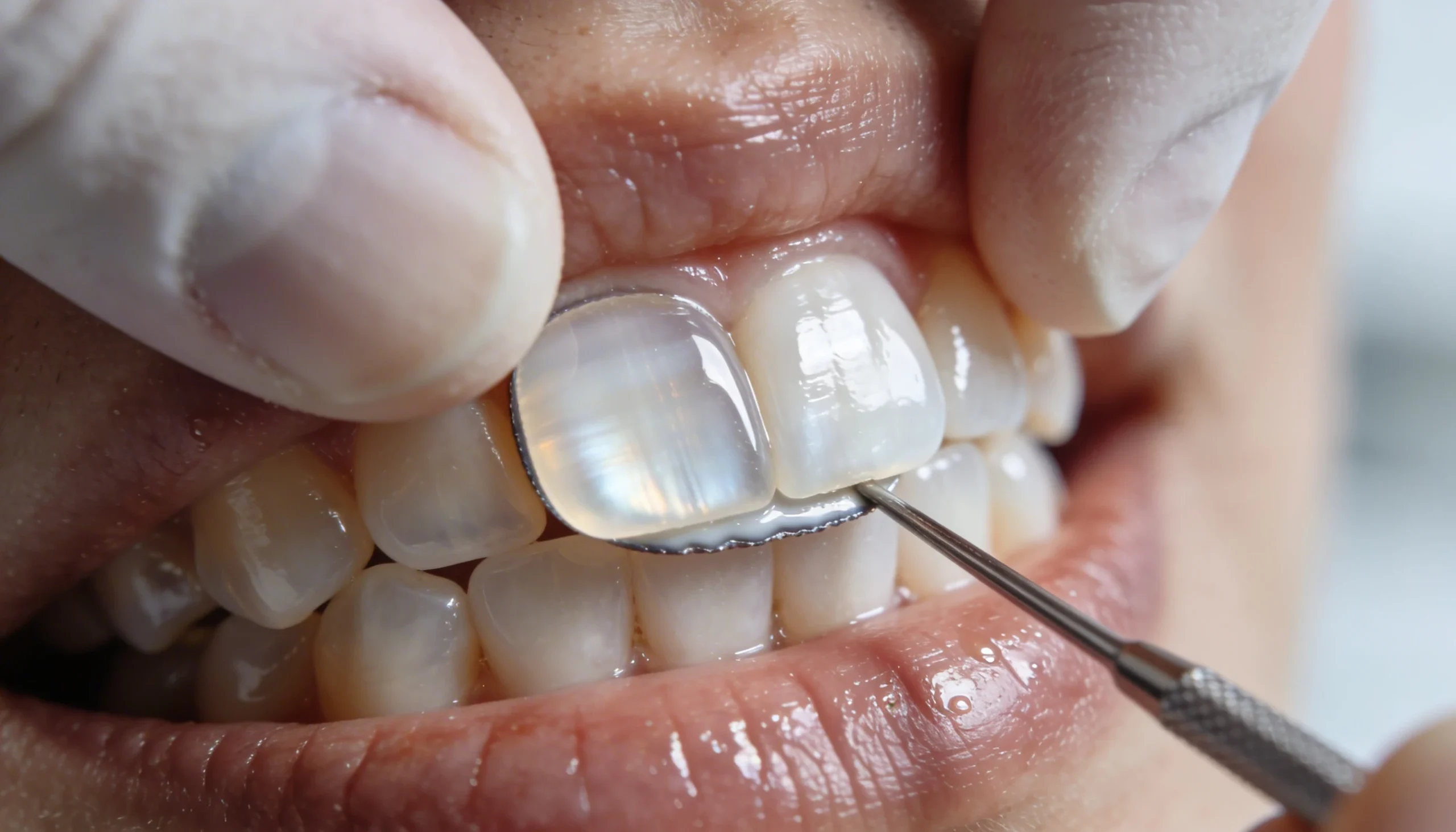
Step 8: Positioning and Bonding the Veneer
The dentist carefully seats the veneer against the prepared tooth, applying controlled pressure to establish the correct position.
Excess cement is removed from the margins, and the bonding material is cured using the technique specified for that cement.
Many veneer restorations use light-cured resin cement, while other situations may require dual-cure materials.
Once the cement has hardened, the veneer is firmly attached to the tooth.
Step 9: Bite Adjustment and Final Polishing
The dentist checks how the teeth meet when you close your mouth and move your jaw.
Any high contacts or uncomfortable edges are evaluated and adjusted when necessary.
The veneer margins are finished and polished to support comfort, appearance, and oral hygiene.
Finally, the dentist explains how to care for the restorations and whether a follow-up appointment is needed.
How Are Composite Veneers Attached to Teeth?
Composite veneers are usually attached using a direct bonding technique.
Instead of creating an external porcelain shell in a laboratory, the dentist places tooth-coloured composite resin directly onto the visible tooth surface.
The process commonly involves:
- Consultation and shade selection: The dentist checks oral health and selects an appropriate resin shade.
- Surface preparation: The tooth is cleaned and conditioned for bonding.
- Adhesive application: A dental bonding system is used according to the selected material.
- Composite placement: Resin is applied and sculpted to improve tooth shape, proportions, or colour.
- Light curing: A dental curing light hardens the composite material.
- Finishing and polishing: The dentist refines the contours, checks the bite, and polishes the final restoration.
Direct composite veneers can often be completed in one appointment, although larger smile transformations may require additional visits.
Compared with porcelain veneers, direct composite treatment often requires less enamel removal and may be easier to repair if small chips or surface staining develop.
Can Veneers Be Attached Without Shaving Teeth?
In selected cases, yes. No-prep or minimal-prep veneers may be attached with little or no removal of enamel.
However, not every tooth is suitable for this approach.
No-prep veneers may be considered when tooth position, shape, and available space allow a thin restoration to be added without producing excessive bulk.
Preparation may still be necessary when:
- Teeth are prominent or rotated.
- The proposed veneers would appear too thick.
- The gumline or tooth contours require correction.
- Existing restorations affect the bonding surface.
- A darker natural tooth shade needs additional masking.
No-prep does not automatically mean completely reversible. Even when significant drilling is avoided, bonding and surface conditioning can alter the tooth surface.
The safest approach is to choose the preparation technique after a detailed examination rather than selecting a veneer type based only on advertising claims.
How Long Does It Take to Attach Veneers?
The treatment timeline depends on veneer material, the number of teeth, laboratory work, and the complexity of your smile design.
| Procedure | Typical Timeline |
|---|---|
| Direct composite veneers | Often completed in one visit |
| Porcelain veneers | Usually two or more appointments |
| Laboratory fabrication | Often around one to several weeks, depending on the laboratory |
| Multiple veneers or complex smile design | May require additional planning or adjustment visits |
| Follow-up appointment | Scheduled when clinically appropriate |
Actual appointment length varies. A single veneer is generally quicker to fit than several veneers requiring careful adjustment of tooth contacts and bite balance.
At Alma Polyclinic’s 3D dental veneers service in Dubai, treatment planning includes an assessment of tooth shape, colour, proportions, and the desired smile result.
Does Getting Veneers Attached to Teeth Hurt?
Veneer placement is generally manageable for most patients.
If tooth preparation is necessary, the dentist may use local anaesthesia to reduce discomfort.
During final placement, you may feel pressure while the veneers are positioned, but the bonding process itself should not cause significant pain.
Some patients experience temporary sensitivity after tooth preparation or bonding, particularly when eating hot or cold foods.
Mild sensitivity usually improves, but persistent or severe pain should be evaluated.
How Long Do Veneers Stay Attached to Teeth?
Veneers are designed as long-term fixed restorations, but they do not last forever.
Porcelain veneers commonly remain functional for many years, often around 10 to 15 years or longer in favourable circumstances. Composite veneers may require repairs, polishing, or replacement sooner.
These are approximate expectations rather than guaranteed lifespans.
The durability of veneer attachment depends on:
- How much healthy enamel is available for bonding
- The type and quality of restorative material
- Accuracy of veneer fit and bonding
- Bite forces and teeth grinding
- Daily oral hygiene
- Diet and oral habits
- Regular dental examinations
A veneer may become loose, chip, crack, or require replacement over time.
Patients considering treatment should understand both the aesthetic benefits and possible limitations. Our article are veneers bad for your teeth? explores the risks, benefits, and importance of preserving natural tooth structure.
What Happens if a Veneer Comes Off?
Although veneers are securely bonded, detachment can occasionally occur because of excessive biting forces, damage, a bonding problem, or changes affecting the supporting tooth.
If a veneer becomes loose or falls off:
- Keep the veneer in a clean, safe container if you can retrieve it.
- Avoid chewing directly on the affected tooth.
- Do not attempt to attach it with household glue or an over-the-counter adhesive.
- Contact your dentist to arrange an examination.
The dentist will assess the condition of the veneer, natural tooth, and bonding surface.
Some intact veneers may be suitable for professional reattachment, while damaged or poorly fitting restorations may require replacement.
Seek prompt dental advice if a detached veneer leaves a sharp edge, causes significant sensitivity, or exposes a damaged tooth.
How Should You Care for Veneers After Attachment?
Good veneer aftercare helps protect the bonding margins, supporting teeth, gums, and restorative materials.
Brush and Floss Regularly
Brush twice daily using a soft-bristled toothbrush and fluoride toothpaste. Clean between your teeth every day.
Veneers cannot develop cavities, but the natural teeth underneath and around them can still decay.
Avoid Excessive Pressure on Veneers
Do not use veneered teeth to open packaging, bite fingernails, or chew ice, pens, and other hard objects.
These habits can increase the risk of chipping, fracture, or detachment.
Manage Teeth Grinding
If you grind or clench your teeth, tell your dentist before treatment.
Bruxism and certain bite conditions can place substantial forces on veneers. A dentist may recommend managing the grinding habit or using a suitable nightguard.
Reduce Staining Habits
Porcelain is generally more resistant to surface staining than composite resin. However, exposed bonding margins and surrounding natural teeth can still become discoloured.
Regular cleaning and limiting tobacco exposure can help preserve the appearance of your smile.
Attend Regular Dental Check-Ups
Professional examinations allow your dentist to monitor veneer margins, gum health, bite contacts, and signs of wear.
For additional maintenance recommendations, see how to maintain your smile after cosmetic dental procedures.
Veneers vs Crowns vs Composite Bonding: How Are They Attached?
Veneers, crowns, and direct composite bonding all involve restorative materials, but they differ in how much tooth structure they cover and how they are attached.
| Treatment | How It Is Attached | Coverage and Purpose |
|---|---|---|
| Porcelain Veneers | Custom ceramic shells bonded using dental adhesive and resin cement | Usually cover the visible front tooth surface for cosmetic improvement |
| Dental Crowns | Custom restorations secured with a suitable dental cement or bonding system | Cover most or all of the prepared tooth to restore damaged structure and function |
| Composite Bonding | Tooth-coloured resin directly bonded, shaped, and light-cured | Often used for smaller chips, gaps, and cosmetic contour changes |
Veneers are generally considered when the natural tooth remains sufficiently healthy and the main goal is cosmetic improvement.
Crowns may be recommended when a tooth needs greater structural restoration or protection.
For a more detailed comparison, read dental veneers vs crowns: which is right for you?.
Are Veneers the Right Choice for Your Teeth?
Not everyone who wants a brighter or more symmetrical smile needs veneers.
Veneers may be an appropriate option for selected cases involving:
- Chipped or worn front teeth
- Persistent tooth discolouration
- Small gaps between teeth
- Uneven tooth shapes or proportions
- Minor cosmetic alignment concerns
- Smile asymmetry
However, untreated gum disease, active decay, significant tooth damage, severe grinding, or certain bite problems may make veneer treatment unsuitable until the underlying condition is addressed.
If your main concern is tooth colour rather than shape, professional teeth whitening in Dubai may be worth discussing before considering irreversible cosmetic treatment.
For patients seeking a broader smile transformation, Hollywood Smile treatment in Dubai may involve a personalised combination of veneers, whitening, bonding, and other appropriate dental procedures.
Frequently Asked Questions About Veneer Attachment
How are veneers permanently attached to teeth?
Porcelain veneers are attached using professional dental adhesive systems and resin cement. The dentist prepares the tooth and veneer surfaces, positions the restoration, and cures the bonding material. Composite veneers are generally applied directly to the tooth and hardened using a dental curing light.
What keeps veneers attached to teeth?
Veneers remain attached through dental adhesion between the tooth surface and restorative material. For porcelain veneers, bonding agents and resin cement create the connection. Proper enamel preparation, isolation, material conditioning, and curing contribute to reliable attachment.
Do dentists shave teeth before attaching veneers?
Traditional porcelain veneers usually require some enamel reshaping. However, the amount varies depending on tooth anatomy, position, and veneer design. Some minimal-preparation veneers may be suitable without significant enamel removal.
Are veneers attached with glue?
Veneers are not attached with ordinary glue. Dentists use specialised adhesive systems and dental resin cements designed for restorative treatment.
Can veneers be attached to damaged teeth?
It depends on the condition of the tooth. Small chips or minor cosmetic defects may be suitable for veneers, but extensive decay, major fractures, or insufficient healthy tooth structure may require another treatment, such as a crown.
How long does it take to put veneers on teeth?
Direct composite veneers can often be completed in one appointment. Porcelain veneers usually require at least two visits because the restorations are custom-made before final placement. Additional appointments may be needed for complex cases.
Do veneers fall off easily?
Properly bonded veneers are designed to remain attached during normal use. However, they can occasionally become loose because of excessive bite forces, damage, bonding failure, or changes in the underlying tooth.
Can a dentist reattach a fallen veneer?
Sometimes. If the veneer is intact and still fits properly, professional reattachment may be possible. Your dentist must examine the restoration and supporting tooth before deciding whether repair, rebonding, or replacement is appropriate.
Can veneers be removed without damaging teeth?
Removing bonded veneers requires professional dental treatment. Traditional veneers often involve permanent enamel removal during preparation, so the original tooth surface cannot simply be restored to its previous state after removing the veneer.
Can you eat normally after veneers are attached?
Many patients can return to normal eating once any local anaesthesia has worn off and the dentist has confirmed that the restorations are properly bonded. Follow individual instructions and avoid biting hard objects or placing excessive pressure on the veneers.
Can cavities develop under veneers?
Yes. While the veneer material itself does not decay, the natural tooth beneath and around the restoration can still develop cavities. Brushing, interdental cleaning, and regular dental examinations remain essential.
Get Dental Veneers in Dubai at Alma Polyclinic
Understanding how veneers are attached to teeth helps you make an informed decision about improving your smile.
Successful veneer treatment involves careful planning, preservation of healthy tooth structure, appropriate material selection, precise bonding, and ongoing maintenance.
At Alma Polyclinic in Jumeirah, Dubai, patients can explore personalised veneer and cosmetic dental treatments based on their oral health, facial features, and aesthetic goals.
Dr. Homa Shahakbari, Founder of Alma Polyclinic and a cosmetic and general dentist, provides smile design and restorative dentistry services.
Explore our 3D dental veneers in Dubai to learn about treatment options, or book a dental consultation at Alma Polyclinic for a personalised assessment.
Medical disclaimer: This article is for educational purposes only and does not replace professional dental examination, diagnosis, or treatment. Veneer suitability, preparation requirements, and bonding techniques depend on individual clinical circumstances.