About the Author and Medical Reviewer
Learn more about the professionals responsible for writing and medically reviewing this article.

Alma Polyclinic Editorial Team
Medical Content Team at Alma Polyclinic
The Alma Polyclinic Editorial Team creates clear, patient-focused health content based on trusted medical sources and clinical guidance from our doctors.
View author profile
Dr. Marc Habib
Specialist Endodontist | Microscopic Root Canal Expert at Alma Polyclinic
This article was reviewed for clinical accuracy, relevance and patient safety by Dr. Marc Habib.
View doctor profileIf you are experiencing pain, pressure or sensitivity between two teeth, you may wonder whether you need a root canal in that area. The important thing to understand is that a root canal is not performed in the space between teeth. Root canal treatment is performed inside an individual tooth when the pulp — the soft tissue containing nerves and blood vessels — becomes inflamed, infected or damaged.
Pain that feels as though it comes from between two adjacent teeth can have several possible causes. The problem may originate from one tooth, both teeth, the gums, trapped food, a cavity between the teeth, a crack, an old restoration or inflammation caused by bite pressure.
Because dental pain can be difficult to localise, accurate diagnosis is essential before treatment begins. A dentist or endodontist may use your symptoms, clinical examination, pulp sensibility tests, X-rays, gum assessment and, in selected complex cases, advanced imaging to determine which tooth is actually responsible.
What Does “Root Canal Treatment Between Two Teeth” Mean?
Patients usually use the phrase root canal treatment between two teeth to describe one of several situations:
- Pain or pressure that feels as though it is coming from the space between two teeth.
- A cavity that has developed where two neighbouring teeth touch.
- Uncertainty about which of two adjacent teeth is causing pain.
- Concern that both neighbouring teeth may need root canal treatment.
Each tooth has its own pulp chamber and root canal system. If one tooth has irreversible pulp inflammation or infection, only that tooth should receive root canal treatment unless testing shows that the neighbouring tooth has a separate problem requiring treatment as well.
A dentist should therefore diagnose each tooth independently rather than treating both simply because the discomfort is felt between them.
Why Can Pain Between Two Teeth Be Difficult to Diagnose?
Dental pain does not always point accurately to the tooth causing the problem. Nerve-related pain may be referred to a neighbouring tooth or may feel as though it comes from a wider area of the jaw.
Several dental conditions can create similar symptoms.
Deep Decay Between Teeth
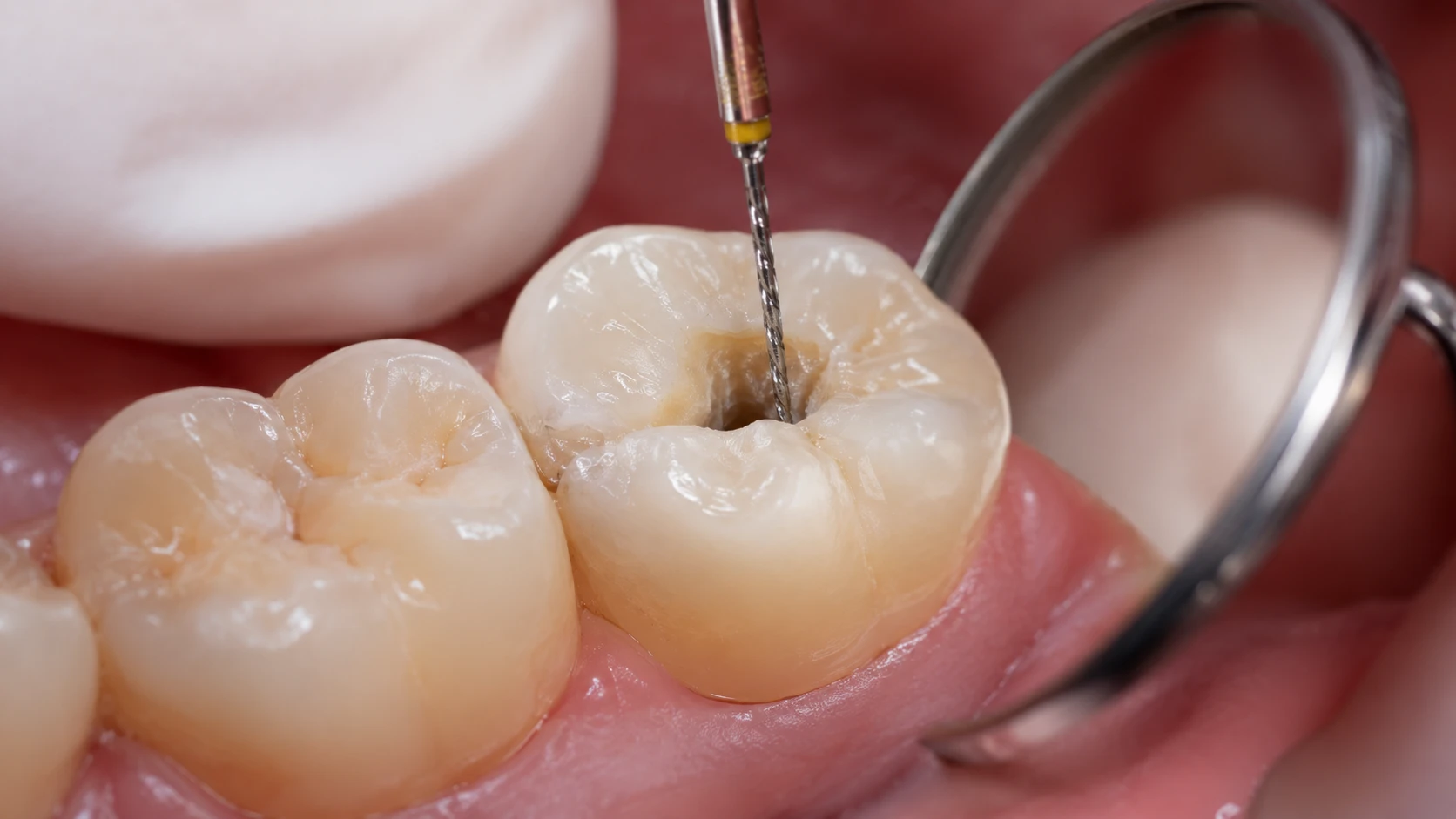
Decay can develop on the side surfaces where two teeth contact each other. These cavities are known as interproximal cavities and may be difficult to see without dental X-rays.
If the decay is limited to the enamel or dentine and the pulp remains healthy, a filling or another restoration may be sufficient. If decay reaches or causes irreversible damage to the pulp, root canal treatment may be required for the affected tooth.
Food Trapping and Gum Inflammation
Food trapped repeatedly between two teeth can irritate the gum tissue and produce pressure, soreness or pain that may feel like a toothache.
In this situation, root canal treatment may not be necessary. The dentist may instead need to evaluate the contact between the teeth, clean the area, treat gum inflammation or replace a poorly shaped restoration.
Cracked Teeth
A cracked tooth can produce sharp pain when biting or when releasing pressure. Depending on the location and depth of the crack, treatment may range from restoration and monitoring to root canal treatment or, in severe cases, extraction.
Inflammation Around the Root
A tooth with inflammation in the tissues around its root may feel tender when biting or when the dentist taps the tooth. Similar tenderness can sometimes affect neighbouring teeth, which is why comparison testing is useful.
How Does a Dentist Know Which Tooth Needs a Root Canal?
Endodontic diagnosis usually involves combining several findings rather than relying on one symptom or one test.
1. Symptom and Dental History
Your dentist will ask when the pain started, what triggers it and how long it lasts. Important symptoms may include:
- Lingering sensitivity to cold or heat
- Spontaneous tooth pain
- Pain when biting
- Night-time pain
- Swelling
- Drainage or a gum bump
The dentist may also ask about previous fillings, crowns, dental trauma, grinding or clenching and recent dental treatment.
2. Pulp Sensibility Tests
Cold testing is commonly used to compare the response of the suspected tooth with neighbouring teeth. A tooth may respond normally, show unusually prolonged pain or fail to respond.
An electric pulp test may also be used in selected cases. These tests assess the tooth’s sensory response and are interpreted together with the examination, history and imaging.
3. Tapping and Bite Tests
The dentist may gently tap each tooth to check for tenderness around the root. A bite test may also help identify pain associated with cracks or inflammation of the ligament supporting the tooth.
Testing both neighbouring teeth and nearby healthy teeth allows the dentist to compare responses rather than relying only on where the patient feels the pain.
4. Dental X-Rays
Dental X-rays can help identify:
- Deep decay
- Bone changes around the root
- Existing fillings or crowns
- Previous root canal treatment
- Root anatomy
- Signs of infection
Not every early pulp problem or crack is visible on a standard X-ray, so imaging must be interpreted together with clinical findings.
5. Gum and Periodontal Examination
The dentist may measure gum pockets around both teeth. A deep isolated pocket can sometimes indicate periodontal disease, a crack or a combined endodontic-periodontal problem.
This distinction matters because root canal treatment addresses disease inside the tooth but does not treat gum-only disease.
6. CBCT Imaging When Necessary
A three-dimensional CBCT scan may be considered when symptoms remain unclear, anatomy is complex, previous treatment has failed or a crack or hidden lesion is suspected.
CBCT is not required routinely for every root canal diagnosis. The American Association of Endodontists recommends using three-dimensional imaging selectively when the expected diagnostic benefit justifies it.
Learn more about CBCT use in endodontics from the American Association of Endodontists
.
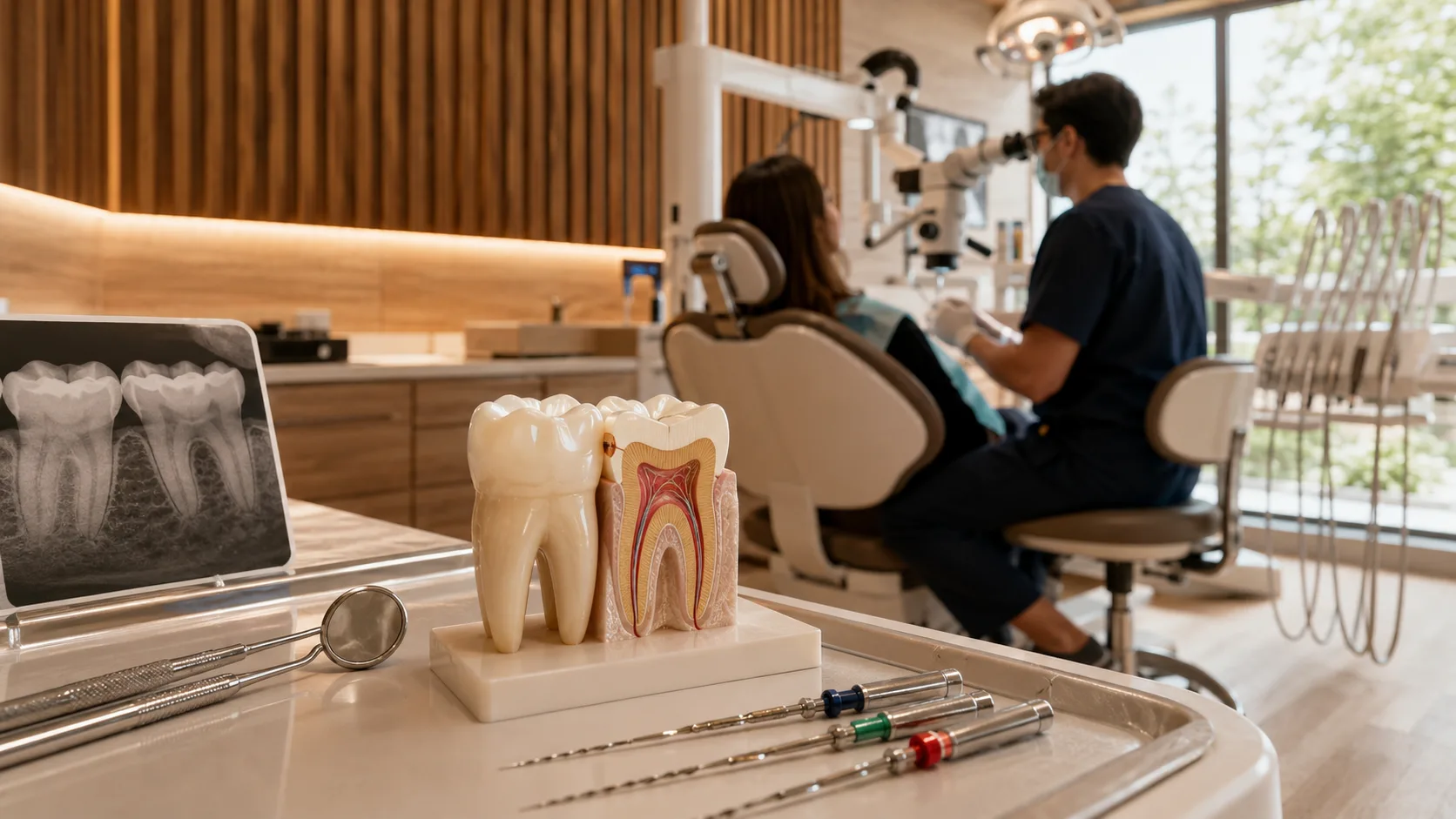
Can Only One of the Two Teeth Need a Root Canal?
Yes. This is a common scenario.
One tooth may have deep decay, pulp inflammation or infection while the neighbouring tooth remains healthy or has a less serious problem that only requires a filling.
If testing identifies one tooth as the source of the problem, root canal treatment is performed on that tooth only.
The neighbouring tooth should not receive root canal treatment unless there is a separate clinical diagnosis supporting it.
Can Two Adjacent Teeth Both Need Root Canals?
Yes, although each tooth must have its own reason for treatment.
Two neighbouring teeth may both require root canal therapy if both have severe decay, pulp infection, trauma, cracks or other irreversible pulpal damage.
When this happens, each tooth has its own root canal system and must be treated individually. Depending on symptoms and urgency, the dentist may treat the teeth during separate appointments or coordinate treatment over the same period.
The key point is that pain between two teeth does not automatically mean both teeth require root canal treatment.
What If There Is a Cavity Between Two Teeth?
A cavity between adjacent teeth does not automatically require a root canal.
If the decay has not caused irreversible pulp damage, the dentist may remove the decay and restore the tooth with a filling or another appropriate restoration.
If the cavity is extremely deep and the pulp has become irreversibly inflamed or infected, root canal treatment may be recommended.
When decay affects the contact surfaces of both neighbouring teeth, each tooth should still be assessed separately. One tooth may need a filling while the other requires root canal treatment.
What Happens During Root Canal Treatment?
If testing confirms that one of the teeth requires root canal treatment, the procedure is performed inside that specific tooth.
Local Anaesthesia and Isolation
Local anaesthesia is used to numb the tooth and surrounding tissues. A dental dam is typically placed around the treated tooth to isolate it and keep the treatment area clean and dry.
Cleaning the Root Canals
An opening is made in the tooth to access the pulp chamber. Inflamed or infected pulp is removed and the canals are carefully cleaned, shaped and disinfected.
Filling and Sealing the Canals
After cleaning and shaping, the canals are filled and sealed with a biocompatible root canal filling material.
The American Association of Endodontists explains that a temporary filling is often placed until the tooth receives its final restoration.
Read the AAE guide to root canal treatment
.
Restoring the Tooth
After root canal treatment, the tooth needs an appropriate permanent restoration to protect it and restore function.
Posterior teeth such as molars and premolars commonly require a crown because they experience significant chewing forces. Front teeth may not always require the same restoration; the decision depends on how much healthy tooth structure remains.
You can learn more about dental crowns after root canal treatment.
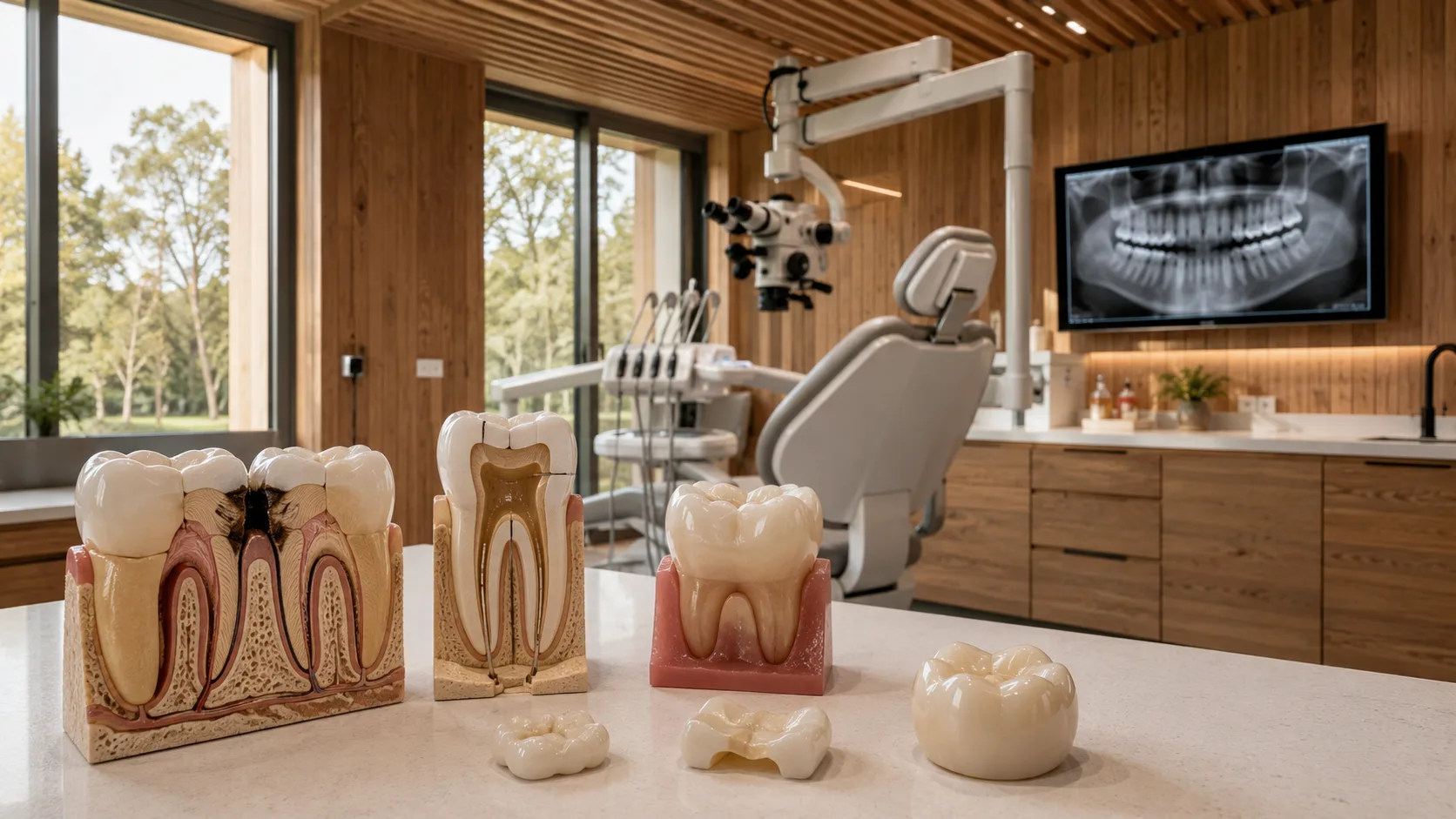
Why Is the Contact Between the Two Teeth Important?
If decay or a restoration affects the side of a tooth, the dentist must recreate an appropriate contact point between the neighbouring teeth.
A well-shaped contact helps:
- Reduce repeated food trapping
- Support healthy gum tissue
- Allow effective flossing
- Maintain normal tooth alignment and function
If food repeatedly gets stuck between the teeth after treatment, or floss constantly shreds, catches or passes through too loosely, ask your dentist to check the contact and restoration contour.
What If the Problem Is the Gum Rather Than the Tooth?
Not every pain between two teeth is an endodontic problem.
If the pulp is healthy but there is gum inflammation, food impaction or periodontal disease, treatment may include professional cleaning, periodontal treatment, improved interdental cleaning or correction of a restoration or contact point.
A root canal would not be expected to solve a purely periodontal problem because the procedure treats the inside of the tooth rather than the gum tissues surrounding it.
In some cases, both endodontic and periodontal disease may be present. These situations require a coordinated diagnosis and treatment plan.
What If the Tooth Cannot Be Restored?
Before performing root canal treatment, the dentist should determine whether the tooth can be predictably restored afterward.
Factors that can affect restorability include:
- A deep crack extending below the gumline
- Extensive decay
- Very limited remaining tooth structure
- Severe periodontal support loss
- Other structural problems affecting long-term prognosis
When a tooth cannot reasonably be restored, extraction and replacement may need to be discussed.
For a broader comparison, see our guide to root canal treatment vs tooth extraction.
Aftercare When Root Canal Treatment Is Done Next to Another Tooth
Mild soreness or tenderness when biting can occur for several days after root canal treatment and should generally improve over time.
Until the tooth has received its final restoration, follow your dentist’s instructions and avoid chewing hard foods heavily on the treated tooth.
Continue brushing and cleaning between the teeth carefully unless your dentist gives different instructions.
The American Association of Endodontists recommends contacting the dental team if severe pain or pressure lasts more than a few days, visible swelling develops, the bite feels uneven or a temporary filling or crown comes out.
Root canal post-treatment guidance from the AAE
.
When Should Pain Between Two Teeth Be Checked Urgently?
Arrange a dental assessment if pain is persistent, recurring or accompanied by swelling, drainage, lingering temperature sensitivity or significant pain when biting.
Dental infections should not be managed with home remedies alone.
Seek urgent medical care if swelling becomes severe or causes difficulty breathing, swallowing or speaking. NHS guidance identifies these symptoms as signs that immediate emergency assessment may be necessary.
Read NHS guidance on dental abscess symptoms
.
You can also read our guide to dental emergencies and severe tooth pain.
When Should You See an Endodontist?
An endodontist specialises in diagnosing tooth pain and treating diseases of the dental pulp and root canal system.
Specialist evaluation may be particularly useful when:
- It is difficult to determine which of two adjacent teeth is causing the pain.
- A molar has complex root canal anatomy.
- A previously root-treated tooth becomes painful again.
- A crack is suspected.
- Symptoms continue despite previous dental treatment.
- Advanced endodontic imaging or treatment may be required.
At Alma Polyclinic, Dr. Marc Habib provides specialist endodontic assessment and root canal treatment in Dubai.
Frequently Asked Questions
Can you have a root canal between two teeth?
No. Root canal treatment is performed inside an individual tooth, not in the space between two teeth. If pain is felt between adjacent teeth, a dentist must determine whether the source is one tooth, both teeth, the gums or another dental problem.
How does a dentist know which of two teeth needs a root canal?
The dentist combines your symptom history with clinical examination, cold or other pulp sensibility tests, tapping and bite tests, X-rays and periodontal assessment. CBCT may be considered selectively when the diagnosis remains unclear or the anatomy is complex.
Can two teeth next to each other both need root canals?
Yes. Two adjacent teeth can both require root canal treatment if each tooth has irreversible pulp inflammation, infection or other pulpal damage. Each tooth should be diagnosed independently before treatment.
Does pain between two teeth always mean I need a root canal?
No. Pain between teeth can be caused by interproximal decay, food trapping, gum inflammation, periodontal disease, cracks, bite pressure or problems with existing fillings and crowns.
Can a cavity between two teeth require a root canal?
Yes, but only if the decay has caused irreversible damage or infection of the pulp. If the pulp remains healthy, a filling or another restoration may be sufficient.
Will I need a crown after the root canal?
It depends on the tooth and how much healthy structure remains. Molars and premolars commonly require crowns or another strong restoration after root canal treatment, while some front teeth can be restored differently.
Why can a neighbouring tooth still hurt after a root canal?
The discomfort may come from normal healing around the treated tooth, bite pressure, a neighbouring tooth, gum inflammation, a crack or another unresolved dental problem. Persistent or worsening pain should be reassessed.
How much does root canal treatment cost if two teeth are involved?
Root canal treatment is planned per tooth rather than per space between teeth. If two adjacent teeth both require treatment, each tooth requires its own diagnosis, root canal procedure and restoration. For detailed pricing factors, see our guide to root canal cost in Dubai.
Book a Root Canal Assessment in Dubai
If you have pain, swelling or sensitivity between two teeth and are unsure which tooth is causing the problem, an examination can help identify the source before unnecessary treatment is performed.
At Alma Polyclinic, our dental team can assess the teeth, gums, existing restorations and X-rays to determine whether the problem requires a filling, periodontal treatment, root canal therapy or another approach.
If the case requires specialist endodontic assessment, you can book an appointment with Dr. Marc Habib.
Medical note: This article provides general educational information and does not replace a dental examination or personalised diagnosis.