
About the Author and Medical Reviewer
Learn more about the professionals responsible for writing and medically reviewing this article.

Alma Polyclinic Editorial Team
Medical Content Team at Alma Polyclinic
The Alma Polyclinic Editorial Team creates clear, patient-focused health content based on trusted medical sources and clinical guidance from our doctors.
View author profile
Dr. Tamara AK
General Dentist | Cosmetic & Aesthetic Dentistry at Alma Polyclinic
This article was reviewed for clinical accuracy, relevance and patient safety by Dr. Tamara AK.
View doctor profileVeneers are one of the most popular cosmetic dentistry treatments for people who want a brighter, more even, and more confident smile. They can improve the appearance of stained, chipped, uneven, slightly gapped, or worn teeth, and they are often part of a complete smile makeover or Hollywood Smile plan.
But if you are asking, “Are veneers bad for you?”, you are asking the right question.
Veneers are not automatically harmful. In many cases, they can be safe, beautiful, and long-lasting when they are planned carefully, placed correctly, and maintained properly. However, they are also not a casual or fully reversible beauty treatment. Most veneers involve some level of tooth preparation, and once enamel is removed, it does not grow back.
The real answer is this: veneers can be bad for your teeth if they are placed on the wrong candidate, prepared aggressively, fitted poorly, or maintained incorrectly. They can also be a successful cosmetic solution when your teeth, gums, bite, and expectations are properly evaluated first.
Before choosing veneers in Dubai, it is important to understand the benefits, risks, alternatives, and long-term responsibilities. This guide explains the main risks clearly, without fear-based language and without overpromising.
Are Veneers Bad for You? What Your Dentist Might Not Tell You
Veneers can create a dramatic transformation, sometimes in a short period of time. That is why they are so popular among patients looking for a camera-ready smile, a Hollywood Smile, or a more balanced appearance.
However, the part many patients do not fully understand is that veneers are a dental restoration, not just a cosmetic accessory.
That means they affect real teeth, real enamel, real gums, and real bite forces. The final result depends on more than the shade or shape you choose. It depends on:
- How much enamel needs to be removed
- Whether your teeth are healthy enough for veneers
- Whether your gums are stable
- Whether you grind or clench your teeth
- How well the veneers fit at the edges
- How carefully the bite is adjusted
- How well you clean and maintain them
So, are veneers bad for you? Not necessarily. But they can become a problem if they are treated like a quick cosmetic shortcut instead of a carefully planned dental procedure.
A good veneer plan should protect tooth structure as much as possible, respect the gumline, consider the bite, and create a smile that looks natural for your face rather than copied from someone else.
What Are Veneers, Really?
Dental veneers are thin, custom-made shells bonded to the front surface of teeth. They are commonly made from porcelain or composite resin and are designed to improve the visible appearance of the smile.
Veneers are often used to correct:
- Deep discoloration that does not respond well to whitening
- Minor chips or worn edges
- Small gaps between front teeth
- Uneven tooth length or shape
- Mild asymmetry in the smile
- Old bonding that stains or breaks repeatedly
- Aesthetic concerns in the front teeth
Most veneers cover the visible front surface of the tooth. Some designs may also wrap slightly around the edge of the tooth to improve strength and appearance. Unlike crowns, veneers usually do not cover the entire tooth, which is why they can be more conservative in suitable cases.
At Alma Polyclinic, Dental Veneers are usually considered as part of a broader smile design plan, not as a one-size-fits-all solution. The goal is to improve the smile while preserving as much healthy tooth structure as possible.
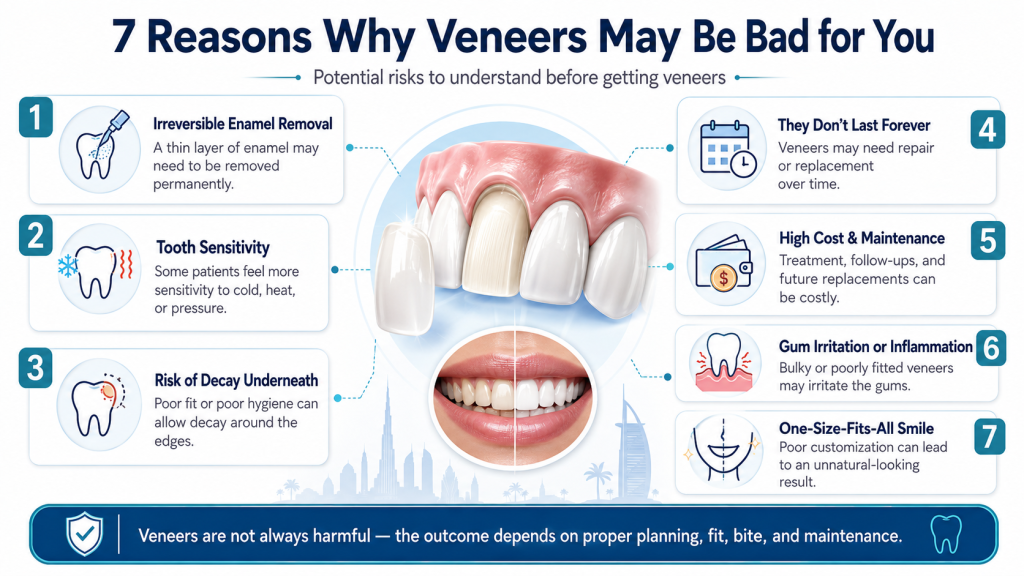
7 Reasons Why Veneers May Be Bad for You
Veneers are not dangerous by default. Still, like any dental treatment, they come with possible risks. Understanding these risks helps you make a more informed decision before starting treatment.
1. Irreversible Tooth Enamel Removal
This is one of the most important things to understand before getting veneers.
In many veneer cases, a thin layer of enamel must be removed from the front surface of the tooth. This creates space for the veneer so the final result does not look bulky or unnatural. It also helps the veneer sit properly and bond securely.
The amount of enamel removed depends on the case. Some patients need very minimal preparation. Others may need more preparation if the teeth are misaligned, dark, bulky, or if a major shape change is planned.
The issue is that enamel does not regenerate. Once it is removed, it cannot grow back naturally.
This means veneers are usually a long-term commitment. If a prepared veneer tooth later needs treatment, you may need:
- A replacement veneer
- Repair work
- A different type of restoration
- Ongoing maintenance over the years
This does not mean veneers are bad in every case. It means the decision should be made carefully. A conservative preparation plan is important, especially for patients with healthy natural teeth.
Before committing, ask your dentist:
- How much enamel will be removed?
- Can the case be done with minimal preparation?
- Are no-prep veneers suitable for my teeth?
- Will the result look bulky if no enamel is removed?
- What happens if I need replacement in the future?
2. Tooth Sensitivity
Tooth sensitivity can happen after veneer preparation or placement. Some patients notice sensitivity to cold drinks, cold air, sweets, or pressure, especially during the first days or weeks.
Mild short-term sensitivity is relatively common and may settle as the teeth adapt. However, sensitivity can become more concerning if it is intense, long-lasting, or triggered by biting.
Possible causes include:
- Too much enamel removal
- Exposed dentin underneath the enamel
- A high bite after placement
- Bonding issues or micro-leakage
- Underlying cracks or decay that were not treated first
- Gum recession exposing sensitive root surfaces
This is why planning matters. Veneers should not be placed without evaluating the tooth structure, bite, and gum health first.
If you already have sensitive teeth, tell your dentist before treatment. You may need a more conservative plan, additional testing, or an alternative treatment such as whitening, bonding, orthodontics, or a staged approach.
3. Risk of Tooth Decay Underneath
Veneers do not get cavities, but the natural tooth underneath still can.
Decay can develop around the edges of veneers, especially near the gumline or between teeth if plaque builds up. The most important area is the margin, which is where the veneer meets the natural tooth.
Decay risk increases when:
- The veneer margin is rough, open, or poorly fitted
- Flossing is difficult because of bulky contours
- Food gets trapped between teeth
- Oral hygiene is inconsistent
- The patient has dry mouth or high cavity risk
- The diet includes frequent sugar or acidic drinks
- Regular dental checkups are skipped
A well-made veneer should allow you to brush and floss normally. Floss should pass between the teeth without shredding, catching, or feeling blocked.
If you notice bleeding gums, bad taste, bad smell, rough edges, or food trapping around veneers, it is important to get them checked. Small margin problems can become bigger dental problems if ignored.
4. They Don’t Last Forever
Veneers are long-lasting, but they are not permanent.
Porcelain veneers can last many years with good care, and composite veneers may require maintenance sooner because composite is more prone to staining, chipping, and surface wear. However, no veneer material lasts forever for every patient.
Veneers may eventually need repair or replacement because of:
- Chipping or cracking
- Wear over time
- Gum recession exposing edges
- Margin staining
- Decay around the veneer
- Changes in bite forces
- Repeated grinding or clenching
- Aesthetic changes over time
Replacement is an important part of the decision. If veneers need to be replaced later, the dentist must remove the old veneer and prepare the tooth again carefully. This is another reason why preserving enamel during the first treatment is so important.
Patients should think of veneers as a long-term investment, not a one-time cosmetic purchase.
5. High Cost and Maintenance
Veneers can be expensive because they require planning, design, preparation, materials, laboratory work, bonding, and follow-up care. The cost may vary depending on the number of teeth treated, the material used, the complexity of the case, and whether additional treatments are needed first.
Common factors that can affect veneer cost include:
- Porcelain vs. composite material
- Number of veneers
- Digital Smile Design planning
- Physical mockup or trial smile
- Gum treatment before veneers
- Teeth whitening before shade matching
- Orthodontic treatment before veneer placement
- Night guard for grinding or clenching
Maintenance also matters. Veneers may require:
- Regular dental checkups
- Professional cleanings
- Polishing or refinishing
- Night guard replacement if needed
- Repairs for chips
- Replacement after years of use
The cheapest option is not always the safest option. Poorly planned veneers can cost more in the long run if they lead to sensitivity, gum irritation, repeated repairs, or early replacement.
6. Potential for Gum Irritation or Inflammation
Healthy gums are essential for successful veneers. Even beautifully shaped veneers can cause problems if they irritate the gum tissue or trap plaque.
Gum irritation may happen if veneers are:
- Too bulky near the gumline
- Poorly polished
- Placed with rough margins
- Designed with overhanging edges
- Difficult to clean between
- Placed before gum disease is treated
Signs of gum problems around veneers can include:
- Bleeding when brushing or flossing
- Swelling around the veneer edges
- Redness or tenderness
- Bad smell or bad taste
- Gum recession
- Visible dark lines near the gumline
Good veneer design should respect the natural gumline. The shape should look smooth and natural, not overbuilt. Cleaning should feel easy, not frustrating.
If you have gum inflammation, bleeding, or periodontal issues, these should be treated before cosmetic veneer work begins.
7. A “One-Size-Fits-All” Smile
One of the biggest aesthetic risks with veneers is ending up with a smile that looks too uniform, too white, too bulky, or too artificial.
This can happen when veneers are chosen based only on a photo, a trend, or a celebrity smile rather than the patient’s own face.
A smile that looks good on one person may not suit another person because every patient has different:
- Face shape
- Lip movement
- Gum display
- Skin tone
- Tooth size
- Jaw shape
- Personality
- Age
- Natural smile style
Good veneers should not simply look perfect. They should look right for you.
This is where Digital Smile Design and physical mockups can be extremely helpful. A digital preview helps you see the planned smile, while a mockup allows you to test the shape and length before the final veneers are made.
At Alma Polyclinic, the goal is not to create a copied smile. The goal is to design a smile that feels balanced, natural, and personalized for the patient.
So… Are Veneers Worth It?
Veneers can be worth it for the right patient, with the right expectations and the right treatment plan.
They may be a good option if you want to improve:
- Tooth shape
- Tooth size
- Tooth color
- Smile symmetry
- Minor chips
- Small gaps
- Worn edges
- Overall smile balance
However, veneers should not always be the first option. In many cases, a more conservative treatment may be better.
Alternatives may include:
- Professional teeth whitening: Best when the main concern is tooth color and the tooth shape is already acceptable.
- Orthodontics or aligners: Best when the main concern is tooth position, crowding, gaps, or bite alignment.
- Cosmetic bonding: Best for small chips, minor gaps, and subtle shape improvements.
- Gum contouring: Best when the smile looks uneven because of gum shape or excess gum display.
- Monitoring: Best when the concern is mild and the patient is not ready for a permanent cosmetic change.
If your concern is only color, start with teeth whitening. If your teeth are crooked, consider alignment first. If the issue is minor chipping, bonding may be enough.
Veneers become more suitable when the cosmetic goal involves several factors at once, such as color, shape, symmetry, and proportion.
Final Thoughts: Think Twice Before You Veneer
Veneers are not automatically bad for you. They can create a beautiful, natural-looking, and confident smile when planned and placed properly. But they are also not risk-free, and they are usually not fully reversible.
The most important thing is to avoid rushing into veneers without understanding the long-term commitment.
Before treatment, make sure you know:
- How much enamel will be removed
- Whether your teeth and gums are healthy enough
- Whether you grind or clench
- Which material is best for your case
- How your bite will be checked
- What alternatives are available
- What maintenance will be required
- When replacement may be needed in the future
If veneers are done without proper planning, they can lead to sensitivity, gum irritation, decay around the edges, chipping, or an unnatural result. If they are done carefully, they can be a predictable and highly satisfying cosmetic treatment.
At Alma Polyclinic in Jumeirah, Dubai, veneer treatment is approached with careful planning, modern smile design, and a focus on long-term oral health. The goal is not only to improve how your smile looks, but also to make sure the treatment is appropriate for your teeth, gums, bite, and expectations.
If you are considering veneers in Dubai, the best first step is a detailed consultation. A personalized evaluation can help you understand whether veneers are the right choice, or whether another treatment would be safer and more conservative for your smile.
FAQ: Are Veneers Bad for Your Teeth?
Are veneers bad for your real teeth?
Veneers are not always bad for real teeth, but they can be harmful if too much enamel is removed, the fit is poor, the bite is not checked, or oral hygiene is not maintained. With proper planning and conservative preparation, veneers can be safe for suitable patients.
Can veneers ruin your natural teeth?
Veneers do not automatically ruin natural teeth. However, aggressive preparation, poor bonding, decay around the edges, or untreated gum problems can damage the teeth over time. This is why a full dental evaluation is important before treatment.
Are there safer alternatives to veneers?
Yes. Depending on your concern, safer or more conservative options may include teeth whitening, orthodontics, cosmetic bonding, gum contouring, or monitoring. The best option depends on whether your main issue is color, shape, alignment, spacing, or tooth wear.
Do veneers hurt?
The veneer procedure is usually comfortable because local anesthesia can be used during tooth preparation. Some patients may experience temporary sensitivity after treatment, especially to cold drinks or pressure. Persistent pain or sensitivity should be checked by a dentist.
Do veneers cause tooth decay?
Veneers themselves do not decay, but the natural tooth underneath can still get cavities. Decay is more likely if plaque collects around the veneer margins, if hygiene is poor, or if the veneer does not fit properly.
Are veneers reversible?
Most traditional veneers are not considered reversible because some enamel may be removed during preparation. Once enamel is removed, the tooth usually needs ongoing coverage with a veneer or another restoration.
How long do veneers last?
Veneer longevity depends on the material, bite forces, oral hygiene, and maintenance. Porcelain veneers usually last longer than composite veneers, but both may eventually need repair or replacement.
Who should avoid veneers?
Patients with active tooth decay, untreated gum disease, severe grinding, very weak enamel, unstable bite issues, or unrealistic expectations may not be good candidates for veneers until those concerns are treated or managed.