About the Author and Medical Reviewer
Learn more about the professionals responsible for writing and medically reviewing this article.

Alma Polyclinic Editorial Team
Medical Content Team at Alma Polyclinic
The Alma Polyclinic Editorial Team creates clear, patient-focused health content based on trusted medical sources and clinical guidance from our doctors.
View author profile
Dr. Tamara AK
General Dentist | Cosmetic & Aesthetic Dentistry at Alma Polyclinic
This article was reviewed for clinical accuracy, relevance and patient safety by Dr. Tamara AK.
View doctor profileWhen planning a smile makeover in Dubai, most patients want the same reassurance before they begin: “Can I see what my new smile will look like before committing to treatment?”
That question is completely reasonable. Veneers, Hollywood Smile treatments, cosmetic bonding, and full smile makeovers can dramatically change the way your teeth, lips, and overall face appear. Before making a decision, you want to know whether the new smile will look natural, suit your face, and feel comfortable in real life.
This is where Digital Smile Design and Physical Mockups become important.
Although these two terms are often used together, they do not mean the same thing.
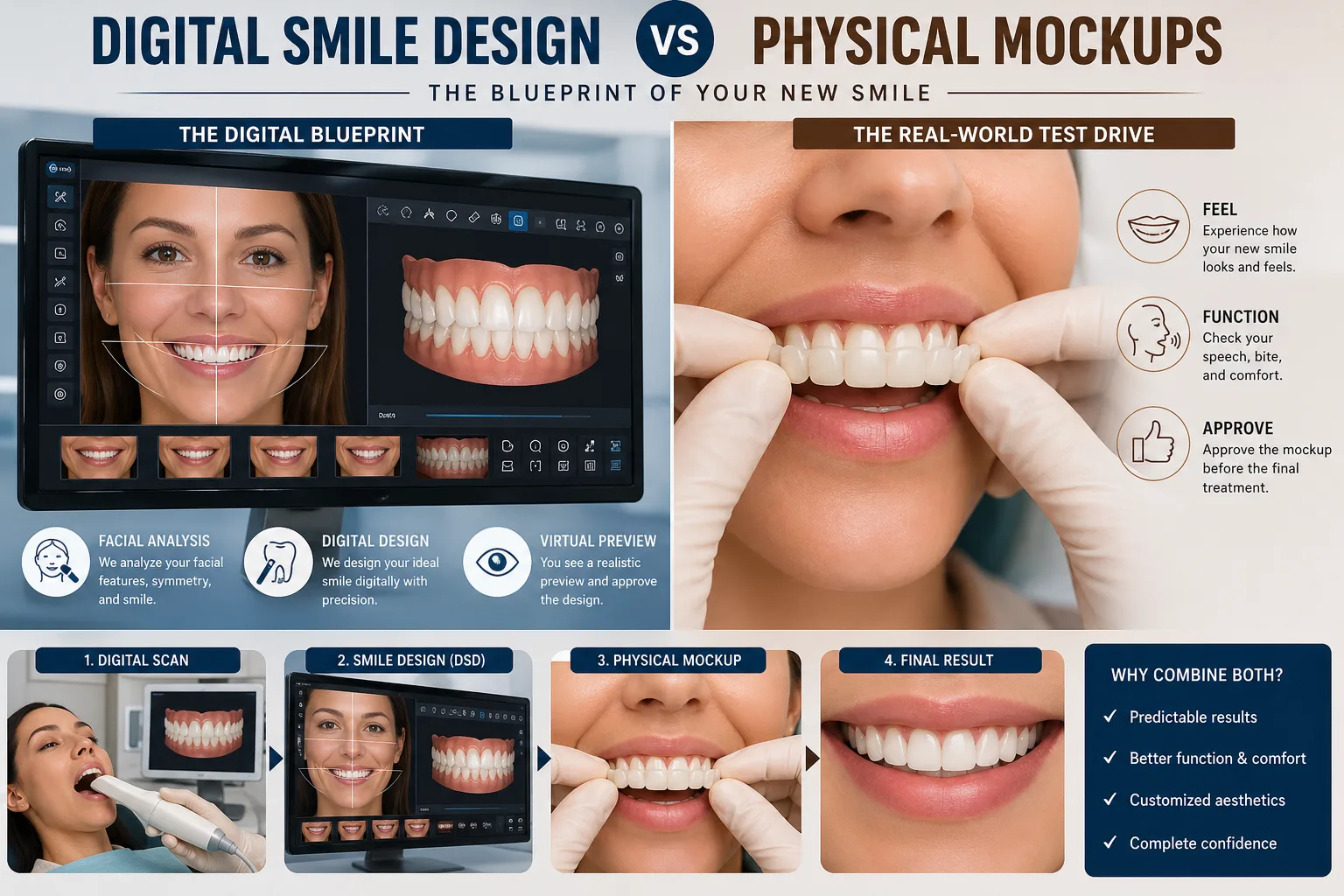
- Digital Smile Design helps you preview and plan your smile digitally.
- Physical Mockups allow you to try a temporary version of that smile inside your mouth.
A simple way to understand the difference is this:
- Digital Smile Design is the blueprint.
- A Physical Mockup is the test drive.
Both are valuable. However, they serve different purposes. Digital Smile Design helps create the visual plan, while the mockup helps confirm how that plan works in real life. For patients considering veneers, Hollywood Smile, or cosmetic dentistry in Dubai, combining both can create a more predictable and confident treatment experience.
What Is Digital Smile Design?
Digital Smile Design, often called DSD, is a modern planning method used in cosmetic dentistry to design a smile based on your facial features, teeth, lips, gum line, and overall appearance.
Instead of planning your smile based only on verbal explanation or imagination, the dentist uses digital tools to create a visual preview of the proposed result.
The goal is not simply to make the teeth look white or straight. A well-planned smile should match your face, personality, lips, and natural expressions.
Digital Smile Design is especially useful for treatments such as:
- Veneers
- Hollywood Smile
- Smile makeover
- Cosmetic bonding
- Teeth reshaping
- Full aesthetic dental rehabilitation
- Complex cosmetic dental planning
How Digital Smile Design Works
The Digital Smile Design process usually begins with a detailed consultation and digital records. These records help the dentist understand not only your teeth, but also how your smile works with your face.
The process may include:
- High-quality facial photographs
- Close-up dental photographs
- Videos of your natural smile
- Videos while speaking or laughing
- Digital scans of your teeth
- Bite analysis
- Smile line evaluation
- Gum line assessment
- Facial symmetry analysis
- Discussion of your smile goals
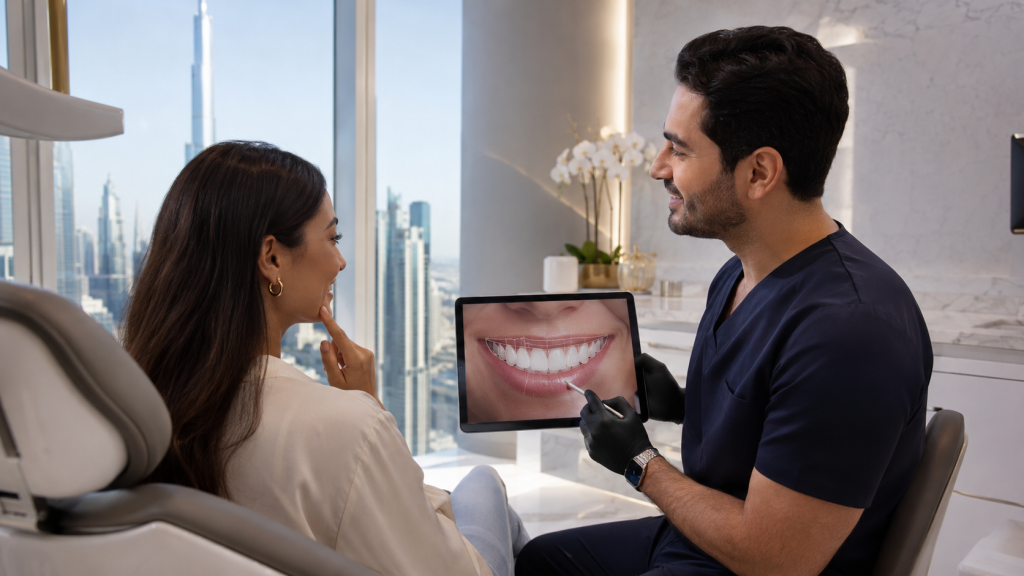
After collecting this information, the dentist uses digital software to design the proposed smile.
This may include planning:
- Tooth length
- Tooth width
- Tooth shape
- Tooth proportions
- Tooth shade
- Smile curve
- Gum-to-tooth balance
- Alignment of the smile with the face
- Harmony between the teeth, lips, and facial structure
The result is a digital preview that helps you understand how your smile could look after treatment.
What Digital Smile Design Helps You See
Digital Smile Design is mainly a visual planning tool.
It helps you preview details such as:
- How your new smile may look from the front
- Whether the tooth shape suits your face
- Whether the smile line looks balanced
- How the teeth may appear when you smile
- How the teeth may fit with your lips
- Whether the planned result looks natural or too dramatic
- The general direction of the final cosmetic outcome
This is very helpful because many patients find it difficult to imagine the final result from technical dental explanations alone.
Instead of hearing, “We will adjust the proportions of your upper front teeth,” you can actually see a proposed version of the result.
That visual clarity makes decision-making easier.
Main Benefits of Digital Smile Design
Digital Smile Design offers several important benefits for patients considering cosmetic dental treatment in Dubai.
Better Visualization
You can see the proposed smile before treatment begins. This reduces uncertainty and helps you understand what the dentist is recommending.
Improved Communication
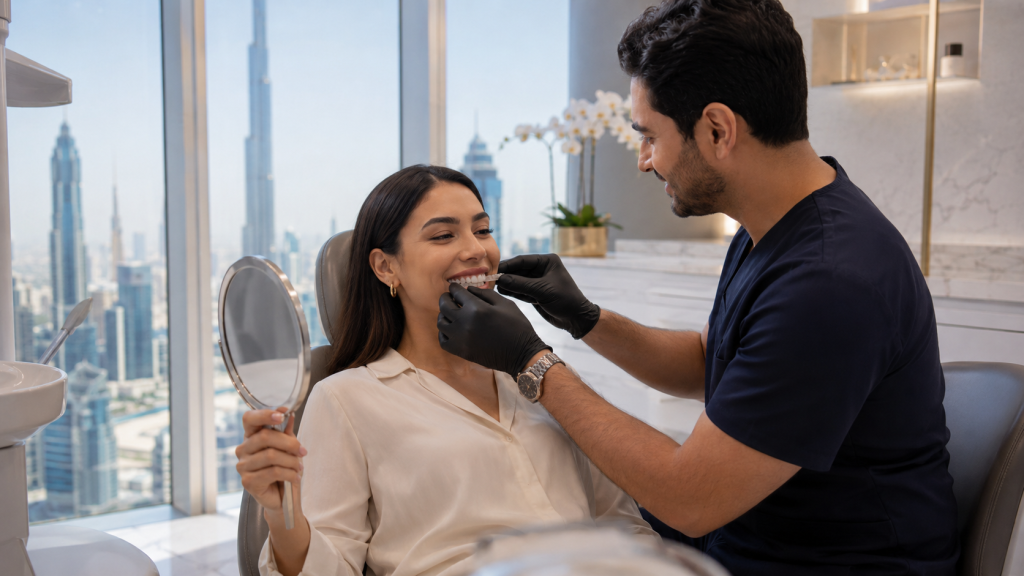
Digital Smile Design creates a shared visual reference between you and your dentist.
Instead of relying only on words, both sides can look at the same design and discuss:
- What looks good
- What feels too bold
- What should be more natural
- Whether the tooth shape suits your face
- Whether the final goal matches your expectations
More Personalized Planning
A good smile design is not copied from another person. It should be created around your own features.
Digital planning allows the dentist to consider:
- Face shape
- Lip movement
- Smile width
- Gum visibility
- Tooth display
- Natural expressions
- Age and aesthetic preference
Fewer Surprises
When the smile is digitally planned before treatment, the patient has a clearer idea of the expected direction.
This does not mean every detail will be identical to the screen preview. However, it does reduce guesswork.
Better Treatment Confidence
For many patients, the biggest benefit is psychological. Seeing a preview can make the treatment feel less uncertain.
This is especially important for patients who are worried about ending up with teeth that look:
- Too white
- Too bulky
- Too long
- Too artificial
- Too different from their natural look
What Are Physical Mockups?
A Physical Mockup is a temporary version of the proposed smile placed directly over your natural teeth.
Unlike Digital Smile Design, which is viewed on a screen, a physical mockup allows you to see and feel the design in your own mouth.
This is why mockups are often described as a “try-in” or “trial smile.”
A mockup is usually made with temporary tooth-colored material. It is not the final veneer or final restoration. Instead, it is a preview that helps you and your dentist evaluate the proposed result before moving forward.
How Physical Mockups Work
A physical mockup is usually created after the design phase.
The process may look like this:
- The dentist completes the smile design
- A model or guide is created based on that design
- Temporary material is placed over your existing teeth
- The new shape is shown directly in your mouth
- You smile, speak, and look at the result
- The dentist checks comfort, function, and aesthetics
- Adjustments can be discussed before final treatment
In many cases, no drilling or permanent change is needed at this stage. The mockup is temporary and used for evaluation.
A physical mockup helps turn a digital idea into a real-life experience.
What Physical Mockups Help You Test
A physical mockup is valuable because it allows you to test things that a digital preview cannot fully show.
With a mockup, you can evaluate:
- How the teeth look in your mouth
- Whether the teeth feel too long
- Whether the teeth feel too bulky
- Whether the smile supports your lips naturally
- How your lips move over the temporary teeth
- Whether your speech feels normal
- Whether certain sounds are affected
- Whether the smile looks natural in the mirror
- Whether the design feels comfortable
- Whether the shape matches your personality
This is especially important because a smile can look attractive on a screen but still feel different in real life.
For example, a digital design may look balanced in a photo, but once tested in the mouth, the patient may feel that the teeth are slightly too long or the shape is too prominent.
That is exactly why mockups matter.
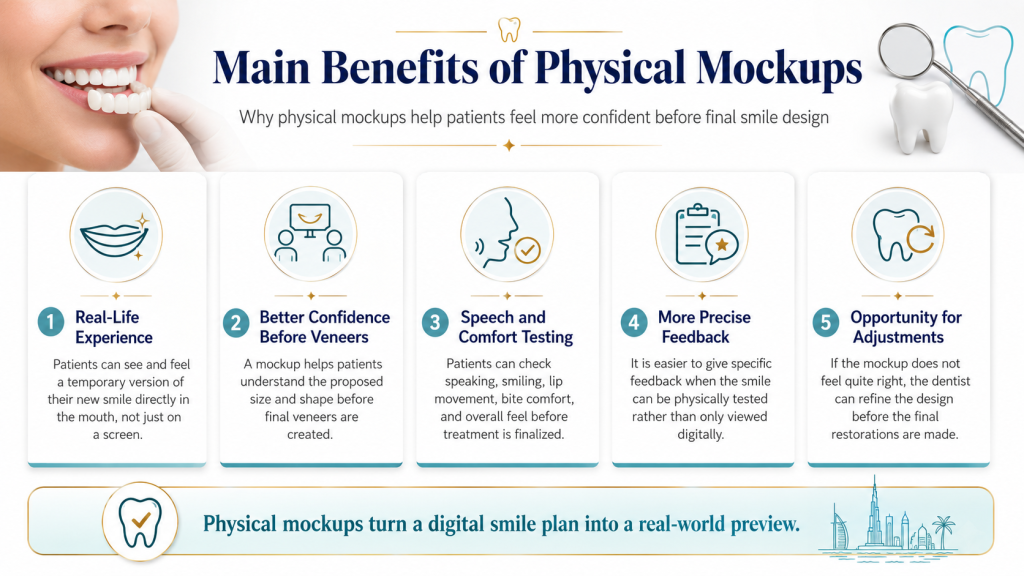
Main Benefits of Physical Mockups
Physical mockups provide benefits that go beyond digital visualization.
Real-Life Experience
You are not just looking at a picture. You are experiencing a temporary version of the smile in your own mouth.
Better Confidence Before Veneers
For patients considering veneers, a mockup can reduce anxiety. It gives you a chance to understand the proposed size and shape before the final veneers are created.
Speech and Comfort Testing
Mockups help assess practical details, including:
- Speaking
- Smiling
- Lip movement
- Tooth volume
- Bite comfort
- Overall feel
More Precise Feedback
It is easier to give feedback when you can actually feel the design.
Instead of saying, “I think the teeth look too long on the screen,” you can say, “When I speak, this length feels a little too much.”
That kind of feedback is more specific and useful.
Opportunity for Adjustments
If the mockup does not feel quite right, the design can often be refined before the final restorations are made.
This may help avoid dissatisfaction later.
Digital Smile Design vs. Physical Mockups: Key Differences
The easiest way to compare Digital Smile Design and Physical Mockups is to look at what each one is best for.
| Feature | Digital Smile Design | Physical Mockup |
|---|---|---|
| Main purpose | Digital planning and visualization | Real-life testing |
| Experience type | Seen on a screen | Tried inside the mouth |
| Best for | Smile proportions and facial harmony | Comfort, speech, lip support, and feel |
| Patient feedback | Based on digital preview | Based on real physical experience |
| Main strength | Helps design the ideal smile | Helps confirm if the design works in reality |
| Main limitation | Cannot fully show how the smile feels | Depends on the quality of the initial design |
| Best use | Planning veneers or smile makeover | Testing the design before final treatment |
The key point is simple:
- Digital Smile Design helps you see the vision.
- A Physical Mockup helps you experience the vision.
Digital Preview vs. Real-Life Try-In
Digital Smile Design is powerful because it creates a visual preview. It helps you understand what your future smile may look like before any final treatment begins.
However, a digital preview is still a preview on a screen.
A Physical Mockup goes further by allowing you to try the design in real life. It lets you see how the shape interacts with your lips, how your smile looks in the mirror, and how the proposed teeth feel while speaking.
Both are useful, but they answer different questions.
Digital Smile Design answers:
- What could my smile look like?
- Does this tooth shape suit my face?
- Is the smile line balanced?
- Does the design match my aesthetic goal?
A Physical Mockup answers:
- Does this smile feel comfortable?
- Do the teeth feel too long or bulky?
- Can I speak naturally?
- Do I like how it looks in real life?
- Would I feel confident with this result?
Which One Is More Accurate?
The answer depends on what type of accuracy you mean.
Digital Smile Design Is Accurate for Planning
Digital Smile Design is accurate for visual planning. It helps the dentist design the smile based on facial proportions, dental records, and aesthetic goals.
It is useful for:
- Planning tooth shape
- Evaluating symmetry
- Creating a smile concept
- Communicating the treatment goal
- Showing the patient a possible result
- Guiding the laboratory or clinical workflow
Physical Mockups Are Accurate for Real-Life Testing
Physical mockups are more accurate when it comes to how the smile feels in your mouth.
They help test:
- Comfort
- Speech
- Lip support
- Tooth volume
- Real-life appearance
- Patient acceptance
A mockup can reveal details that a screen cannot fully predict.
The Best Accuracy Comes from Using Both
Digital Smile Design and Physical Mockups should not be seen as competitors.
They work best together.
- Digital Smile Design creates the plan.
- The Physical Mockup confirms the plan.
When both are used properly, the treatment becomes more predictable and patient-centered.
How Digital Smile Design and Physical Mockups Work Together
For many smile makeover cases, the strongest workflow includes both digital planning and physical testing.
Here is how they usually work together.
Step 1: Smile Consultation
The process begins with a detailed conversation.
The dentist may ask:
- What do you dislike about your current smile?
- Do you want a natural or more glamorous look?
- Are you considering veneers?
- Do you want a Hollywood Smile?
- Are you concerned about tooth color, shape, gaps, or alignment?
- Do you prefer a subtle or dramatic transformation?
This step is important because smile design is not only technical. It is also personal.
Step 2: Digital Records
Next, digital records are collected.
These may include:
- Photos
- Videos
- Digital scans
- Bite records
- Facial analysis
- Tooth shade assessment
These records help the dentist understand the full picture.
Step 3: Digital Smile Design
The proposed smile is designed digitally.
At this stage, the dentist can plan:
- Tooth proportions
- Smile curve
- Tooth edges
- Tooth shade
- Gum balance
- Facial harmony
- Overall aesthetic direction
The patient can review the design and provide feedback.
Step 4: Physical Mockup
Once the digital design is approved, it can be transferred into a physical mockup.
This gives the patient a chance to try the planned smile in real life.
The patient can check:
- How it looks in the mirror
- How it feels with the lips
- How speech feels
- Whether the teeth feel too large
- Whether the smile matches their expectations
Step 5: Adjustments
If needed, changes can be made before the final treatment.
Possible adjustments may include:
- Shortening tooth length
- Softening tooth edges
- Changing tooth shape
- Adjusting proportions
- Refining the smile curve
- Choosing a different shade
- Making the design more natural or more glamorous
Step 6: Final Smile Makeover
Once the patient and dentist are satisfied, the final treatment can begin with greater confidence.
This may include veneers, bonding, crowns, whitening, Invisalign, or a combination of cosmetic dental treatments.
When Is Digital Smile Design Recommended?
Digital Smile Design is recommended for patients who want a clear visual plan before cosmetic dental treatment.
It is especially useful if you are considering:
- Veneers in Dubai
- Hollywood Smile treatment
- Smile makeover
- Cosmetic dentistry
- Tooth reshaping
- Gum contouring
- Full smile rehabilitation
- A more natural-looking smile transformation
It is also useful if you are unsure about what type of smile suits your face.
For example, you may know that you want a brighter smile, but you may not know whether you need:
- Longer teeth
- Softer edges
- A wider smile
- More symmetry
- A different shade
- Minor alignment correction
- A complete veneer plan
Digital Smile Design helps clarify the direction before treatment begins.
When Is a Physical Mockup Recommended?
A Physical Mockup is recommended when the patient wants to experience the proposed smile before making a final decision.
It is especially helpful before:
- Veneers
- Hollywood Smile
- Smile makeover
- Cosmetic bonding
- Major tooth shape changes
- Aesthetic rehabilitation
- Cases where tooth length or volume will change
A mockup is also useful for patients who are nervous about the final appearance.
You may benefit from a mockup if you are asking questions such as:
- Will veneers look too big on me?
- Will my smile still look natural?
- Will the new shape affect my speech?
- Will my lips look different?
- Will the result look too white or artificial?
- Can I try the smile before final treatment?
For many patients, the mockup is the moment when the treatment becomes real.
Do You Need Both Digital Smile Design and a Physical Mockup?
In many cosmetic dentistry cases, using both is the ideal approach.
Digital Smile Design alone can show you the proposed result, but it cannot fully show how the smile feels inside your mouth.
A mockup alone can show you a temporary physical version, but without careful digital planning, it may not be as precise or facially balanced.
That is why the combination is so useful.
Together, they help answer both sides of the decision:
- Does the smile look right?
- Does the smile feel right?
For patients planning veneers or a Hollywood Smile in Dubai, this combination can be especially valuable because expectations are often high. Patients want a result that looks beautiful, but they also want it to feel natural and comfortable.
Common Mistakes Patients Make When Planning a Smile Makeover
A smile makeover is a personal decision. However, patients sometimes make choices based on incomplete information.
Here are some common mistakes to avoid.
Choosing a Smile Based Only on Photos
Many patients bring celebrity photos or social media references to their consultation.
This can be helpful for inspiration, but it should not be copied directly.
A smile that looks beautiful on one person may not suit another person’s:
- Face shape
- Lip position
- Gum display
- Skin tone
- Tooth structure
- Personality
- Age
- Natural expressions
The best smile design should be customized, not copied.
Skipping the Mockup Stage
Some patients feel ready after seeing the digital preview. However, skipping the mockup may mean missing important real-life details.
A mockup can help identify whether:
- The teeth feel too thick
- The edges feel too long
- The smile looks too bold
- The speech feels different
- The lip support feels uncomfortable
Focusing Only on Tooth Color
A bright smile is not always a better smile.
Tooth color is only one part of smile design. Other important factors include:
- Tooth shape
- Tooth proportion
- Symmetry
- Translucency
- Gum balance
- Smile curve
- Natural texture
- Facial harmony
A natural-looking smile usually depends on balance, not just whiteness.
Expecting Every Hollywood Smile to Look the Same
The term “Hollywood Smile” is popular in Dubai, but it should not mean a one-size-fits-all result.
Some patients want a bright and glamorous smile. Others want a softer and more natural look.
A good cosmetic dentist should help design a smile that matches your preferences while still looking balanced with your face.
Ignoring Function
A smile makeover should not only look good. It should also work well.
The dentist should consider:
- Bite
- Speech
- Comfort
- Tooth strength
- Gum health
- Long-term maintenance
- Oral hygiene
This is another reason why mockups and careful planning are important.
Why This Matters for Smile Makeovers in Dubai
Dubai is known for high standards in aesthetics, wellness, and cosmetic treatments. Many patients looking for cosmetic dentistry in Dubai want a smile that is polished, confident, and camera-ready.
However, a successful smile makeover is not just about creating very white teeth.
A well-designed smile should be:
- Attractive
- Natural-looking
- Comfortable
- Balanced with the face
- Suitable for the patient’s lifestyle
- Functional for speaking and eating
- Designed with long-term oral health in mind
Digital Smile Design and Physical Mockups help make the process more controlled. They allow the patient to participate in the planning and reduce the risk of surprises.
For patients who want cosmetic dentistry that feels carefully planned rather than rushed, this approach can make the treatment journey more reassuring and personalized.
Digital Smile Design vs. Physical Mockups: Which One Is Better?
Neither one is “better” in every situation.
They are different tools for different parts of the smile makeover journey.
Choose Digital Smile Design when you need:
- A visual preview
- A treatment plan
- Facial analysis
- Smile proportion planning
- A clearer idea of the final result
- Better communication with your dentist
Choose a Physical Mockup when you need:
- A real-life trial
- Comfort testing
- Speech evaluation
- Lip support evaluation
- A physical feel of the new smile
- More confidence before final veneers
For the best outcome, the answer is usually not one or the other.
The best approach is:
- Digital Smile Design first.
- Physical Mockup next.
- Final treatment after both are approved.
Final Thoughts
Digital Smile Design and Physical Mockups are both important parts of modern cosmetic dentistry.
Digital Smile Design gives you the vision. It helps you see how your new smile may look and allows your dentist to plan the treatment with greater precision.
A Physical Mockup gives you the experience. It allows you to try the proposed smile inside your mouth and check whether it looks, feels, and functions the way you expected.
For patients considering veneers, Hollywood Smile, or a smile makeover in Dubai, the most predictable approach is often to combine both.
That way, your smile is not planned by guesswork.
It is designed, previewed, tested, refined, and then created with confidence.
FAQs About Digital Smile Design vs. Physical Mockups
What is the difference between Digital Smile Design and Physical Mockups?
Digital Smile Design is a digital preview and planning method used to design your future smile on a screen. A Physical Mockup is a temporary version of that design placed over your teeth so you can see and feel the proposed result in real life.
Is Digital Smile Design enough before veneers?
Digital Smile Design is very helpful before veneers because it shows the proposed result and improves planning. However, a Physical Mockup gives an extra level of confidence because it lets you test the smile inside your mouth before final veneers are made.
Do Physical Mockups damage natural teeth?
In many cases, Physical Mockups are placed temporarily over the teeth without drilling or permanent changes. They are mainly used as a preview before the final cosmetic dental treatment.
Which is better: Digital Smile Design or Physical Mockup?
They serve different purposes. Digital Smile Design is better for visual planning and facial harmony, while a Physical Mockup is better for testing comfort, speech, tooth length, and real-life appearance.
Are mockups necessary before a Hollywood Smile?
Mockups are highly recommended before many Hollywood Smile treatments because they allow patients to preview the shape, size, and feel of the proposed smile before final veneers or restorations are created.
Can I change the design after seeing the mockup?
Yes. One of the main benefits of a Physical Mockup is that it allows you to request small changes before the final treatment begins. This may include adjusting tooth length, shape, proportions, or overall style.
Can Digital Smile Design show the exact final result?
Digital Smile Design can show a strong visual preview, but it should be understood as a planning tool, not an absolute guarantee. The final result also depends on clinical conditions, materials, tooth structure, bite, and the treatment selected.
Who is a good candidate for Digital Smile Design?
You may be a good candidate if you are considering veneers, Hollywood Smile, smile makeover, cosmetic bonding, or any treatment that changes the shape, size, shade, or overall appearance of your smile.
Why are both methods useful for cosmetic dentistry in Dubai?
Patients in Dubai often expect highly aesthetic but natural-looking results. Combining Digital Smile Design with Physical Mockups helps create a treatment plan that is visually attractive, personally customized, and tested before final treatment.